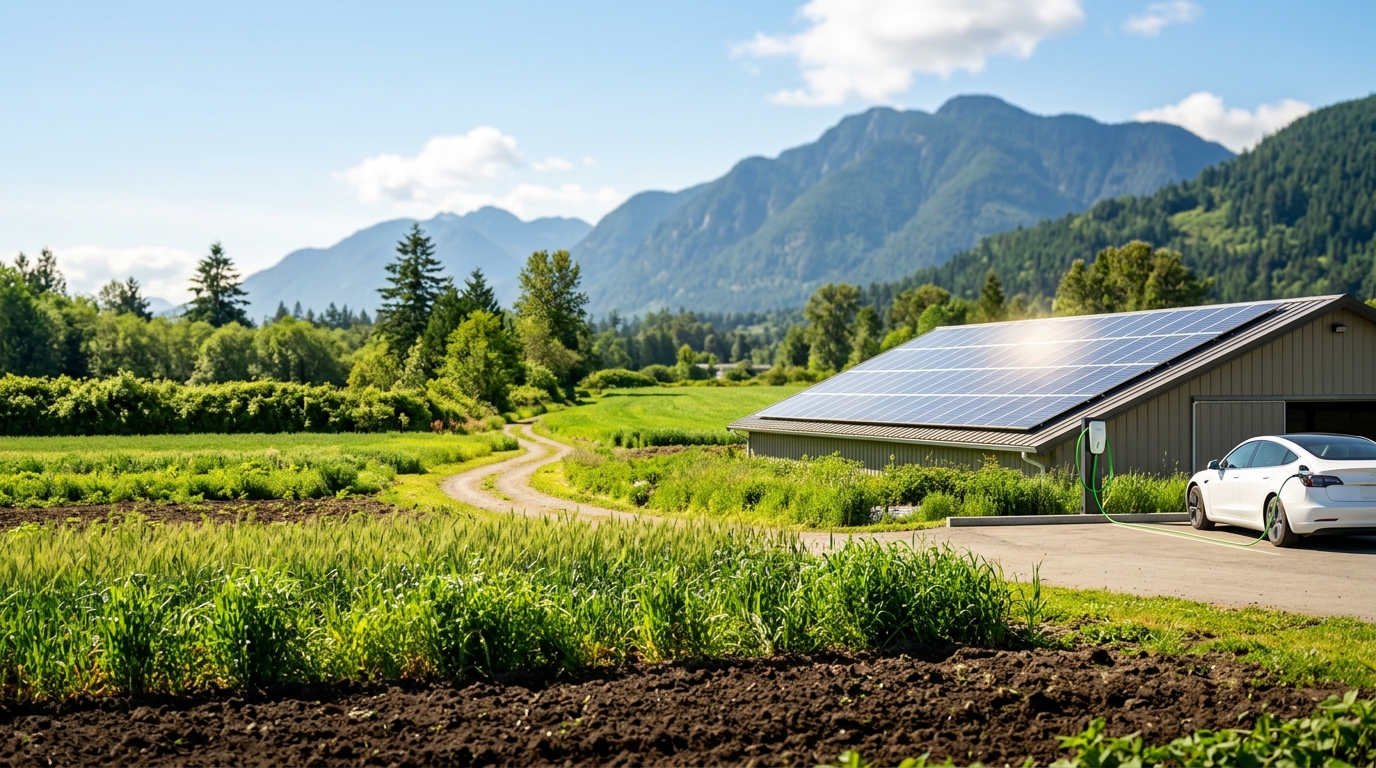
For Fraser Valley grain and vegetable producers navigating thin margins, volatile input costs, and export uncertainty, a new revenue line is taking shape beneath their feet. A cohort of BC farms is completing the first full cycle of soil carbon credit certification under protocols accepted by the federal Output-Based Pricing System (OBPS). This marks a structural shift in how agricultural land generates income, without requiring land conversion or capital-intensive infrastructure.
The financial impact is modest but meaningful. Agronomists working with BC's Ministry of Agriculture and Food estimate participating farms could add $40 to $80 per acre annually through verified soil carbon sequestration credits. For a 500-acre operation, that translates to $20,000 to $40,000 in non-crop revenue—a material contribution when commodity margins are under pressure.
The mechanism is straightforward in principle but complex in execution. Farmers who adopt regenerative practices—such as cover cropping, reduced tillage, compost application, and improved rotations—sequester measurable quantities of carbon in soil organic matter. That carbon can be verified and sold as credits into the federal compliance market via the OBPS or into voluntary markets governed by registries such as Verra's Verified Carbon Standard. The first full certification cycle—baseline measurement, practice adoption, monitoring, third-party verification, and credit issuance—takes approximately three to four years.
The Infrastructure Question
The most consequential development may be the aggregation and measurement layer being assembled around these credits. Individual farms rarely have the technical capacity or transaction volume to navigate certification protocols, soil sampling regimes, and registry submissions alone. This gap has created an opening for agri-tech platforms and aggregators.
Precision agriculture companies operating in BC—including platforms comparable to Farmers Edge—are positioning to provide the remote sensing, soil carbon modelling, and documentation services that make certification economically viable. The aggregator typically captures a service fee or a percentage of credit revenue, while the farmer retains the balance without bearing the full cost of certification.
This aggregation model has precedent in other jurisdictions. In the United States, platforms such as Indigo Ag and Nori built early market share by absorbing certification complexity. The Fraser Valley, with its high farm density and proximity to Vancouver-based agri-food investment capital, is a logical proving ground for a Canadian version of this model.
Federal and Provincial Backing
The financial architecture supporting this transition is substantial. The federal Sustainable Canadian Agricultural Partnership (Sustainable CAP)—the successor to the Canadian Agricultural Partnership—allocates funding to BC for soil health programming, beneficial management practices, and on-farm research. Provincial counterpart funding through BC's Sustainable Agriculture initiative layers additional support for farmers piloting regenerative transitions.
Because these credits are accepted under the federal Greenhouse Gas Offset System and the OBPS, participating BC farms can access a compliance market with established demand, rather than relying solely on the more volatile voluntary market. This compliance backstop reduces revenue risk for early adopters.
Reality Check
The opportunity is significant, but calibration is essential. Soil carbon sequestration rates vary by soil type, baseline organic matter, and climate zone; the Fraser Valley’s wet winters and clay-heavy soils behave differently than the Prairie dryland contexts where much of the protocol science was developed. Independent soil sampling and third-party verification add costs that can erode net credit revenue, particularly on smaller acreages. The BC Agriculture Council has identified measurement and additionality requirements as ongoing friction points for producer uptake.
Permanence risk remains a factor. Soil carbon can be released if land management practices revert, which affects credit pricing and the multi-year commitments required to maintain certification.
Value Capture
Farms best positioned to capture credit revenue in the near term are those with the scale to justify aggregator partnerships, existing data infrastructure, and the agronomic capacity to document practice changes rigorously. Larger grain operations in the eastern Fraser Valley—including the Chilliwack, Abbotsford, and Hope corridors—fit this profile more readily than smaller mixed-vegetable producers.
For investors and agri-food startups, the opportunity lies in the measurement and aggregation layer. The farms completing this first certification cycle are generating more than carbon credits; they are producing verified baseline data, operational protocols, and institutional knowledge regarding the costs and yields of the Fraser Valley certification process. That data is a valuable asset for any platform building at scale.
The market is in its infancy, but the infrastructure is being assembled. The farms completing their first full cycle this season are defining the playbook for the industry.