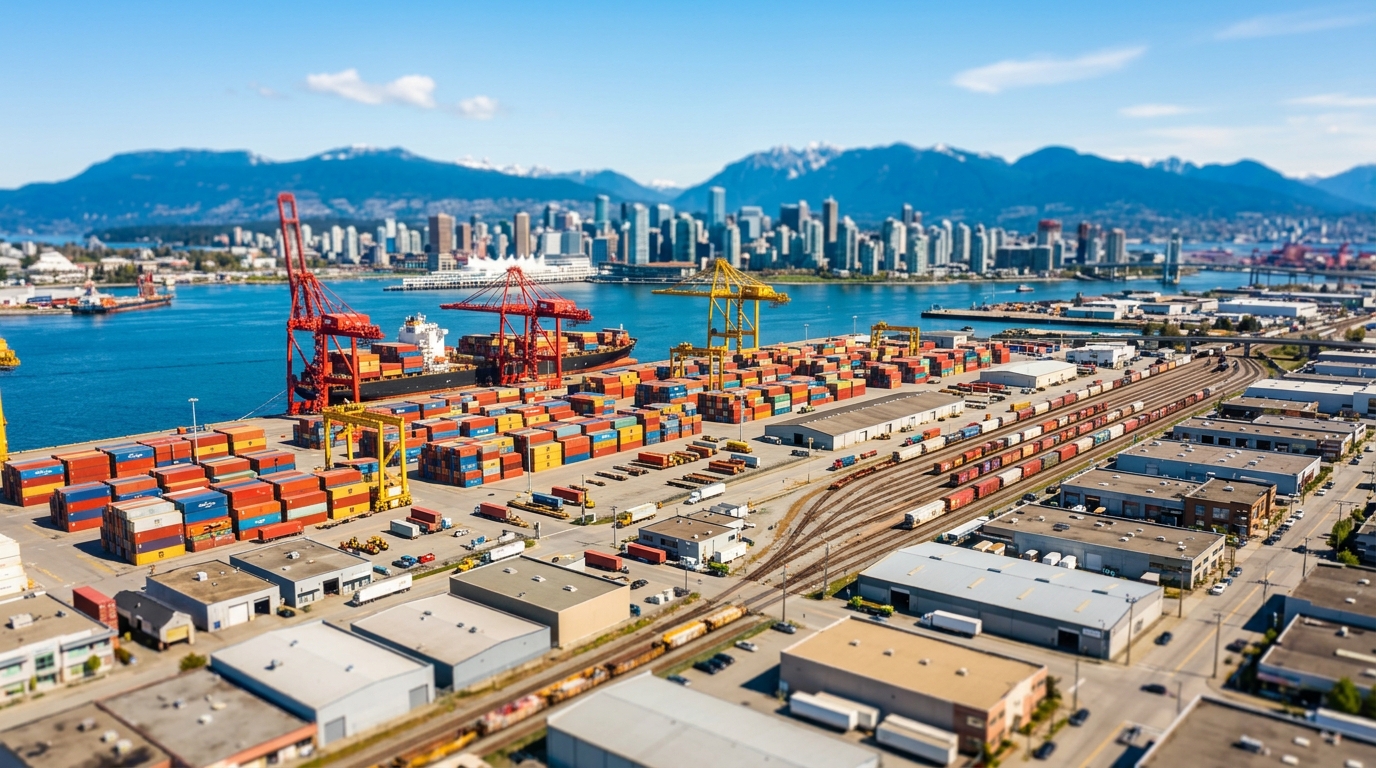
A bitter irony sits at the heart of British Columbia’s reshoring moment. The same trade tensions pushing manufacturers to reconsider their reliance on cross-border supply chains are colliding with a structural reality that no amount of trade policy can quickly fix: Metro Vancouver has almost no industrial land left.
Metro Vancouver's industrial vacancy rate sat at under two per cent in the first quarter of 2026, according to CBRE market data—a figure real estate professionals describe as functionally zero. In practical terms, a manufacturer looking to establish or expand a production facility in the region faces a market where available, move-in-ready space is measured in months of supply, not years. Average asking rents for industrial space in Metro Vancouver have climbed sharply, with some submarkets now exceeding $22 per square foot annually—a price point that strains the economics of many manufacturing operations, which typically run on tighter margins than logistics or distribution.
The structural cause is well understood: Metro Vancouver's buildable industrial land is hemmed in by the Agricultural Land Reserve and the Pacific Ocean. The Metro Vancouver Industrial Lands Strategy has highlighted the depletion of the region's serviced industrial land supply for years. New supply requires not just land but municipal servicing—roads, water, sewer, and hydro—that takes years and tens of millions of dollars to deliver. That timeline does not align with the urgency of a manufacturer trying to make a capital decision in the next twelve months.
The tariff trigger
The pressure is mounting. BC's manufacturing sector has been navigating a turbulent trade environment, and the sustained threat of US tariffs on Canadian goods has moved reshoring from a theoretical conversation to an active capital-planning exercise. Industries with the most exposure—food processing, auto parts, building materials, and light electronics assembly—are evaluating whether producing closer to the Canadian customer base makes financial sense, even at higher domestic operating costs.
The calculus is complex. Reshoring requires finding space, hiring trades, sourcing equipment, and navigating municipal permitting in a high-cost environment. For operations that have watched their margins erode due to tariff uncertainty, the question is shifting from "can we afford to reshore?" to "can we afford not to?"
Where the land actually is
The answer to Metro Vancouver's constraint problem lies east and south, and the municipalities that hold the remaining serviced industrial inventory are positioning themselves to capture this growth.
Surrey is the most significant player. The city has been actively marketing its remaining industrial land in areas like the Campbell Heights Business Park, one of the largest master-planned industrial zones in Western Canada. With direct access to Highway 15 and proximity to the US border, Campbell Heights has attracted logistics, food manufacturing, and light industrial tenants, positioning itself as a landing pad for companies priced out of Burnaby and Richmond.
Pitt Meadows, smaller in scale but strategically located at the intersection of the Lougheed Highway and Golden Ears Bridge corridor, has serviced industrial parcels available at land values substantially below Metro Vancouver benchmarks. The municipality has prioritized attracting manufacturing over pure warehousing, recognizing the economic multiplier effect of production jobs.
Chilliwack represents the frontier. Land values in Chilliwack remain dramatically lower than anywhere in Metro Vancouver, and the city has serviced industrial land available at scale. The trade-off is distance—roughly 100 kilometres from Vancouver—and a labour market that, while growing, lacks the depth of the Lower Mainland's trades workforce. For manufacturers whose supply chains are domestic and whose customers are spread across Canada, that distance matters less than it once did.
The Fraser Valley arbitrage
The land price differential between Metro Vancouver and the Fraser Valley has widened considerably over the past five years. BC Assessment data shows industrial land in Metro Vancouver's tightest submarkets trading at multiples of comparable Fraser Valley parcels—a gap that increasingly determines where capital-intensive manufacturing investments land.
For a manufacturer evaluating a $15-million facility investment, the difference between a $4-million and a $1.2-million land cost is not incidental; it is often the difference between a project that pencils and one that does not. That arithmetic is driving serious conversations in Chilliwack and Pitt Meadows that would not have occurred five years ago.
What this means for the region
The risk for Metro Vancouver is that the reshoring wave largely bypasses the region. The jobs, the tax base, and the economic multiplier effects land in Surrey, Abbotsford, or Chilliwack rather than Burnaby or Richmond. This represents a meaningful shift in where the province's manufacturing economy is physically located.
For investors and operators, the implication is straightforward: industrial land in the Fraser Valley is likely to reprice faster than the market currently anticipates if reshoring demand hardens. Municipalities with serviced inventory and streamlined permitting processes are in a narrow window to attract anchor tenants that will shape their economic character for a generation.
The Canadian Manufacturers & Exporters BC chapter has been tracking the reshoring conversation, noting that while interest is genuine, execution timelines depend heavily on site availability. A manufacturer can decide to reshore in a quarter, but finding and permitting a suitable site can take two years.
That gap—between the urgency of the trade environment and the slow physics of industrial real estate—is the central tension of BC's reshoring moment. The opportunity is real, the clock is running, and for many, the land is in Chilliwack.



