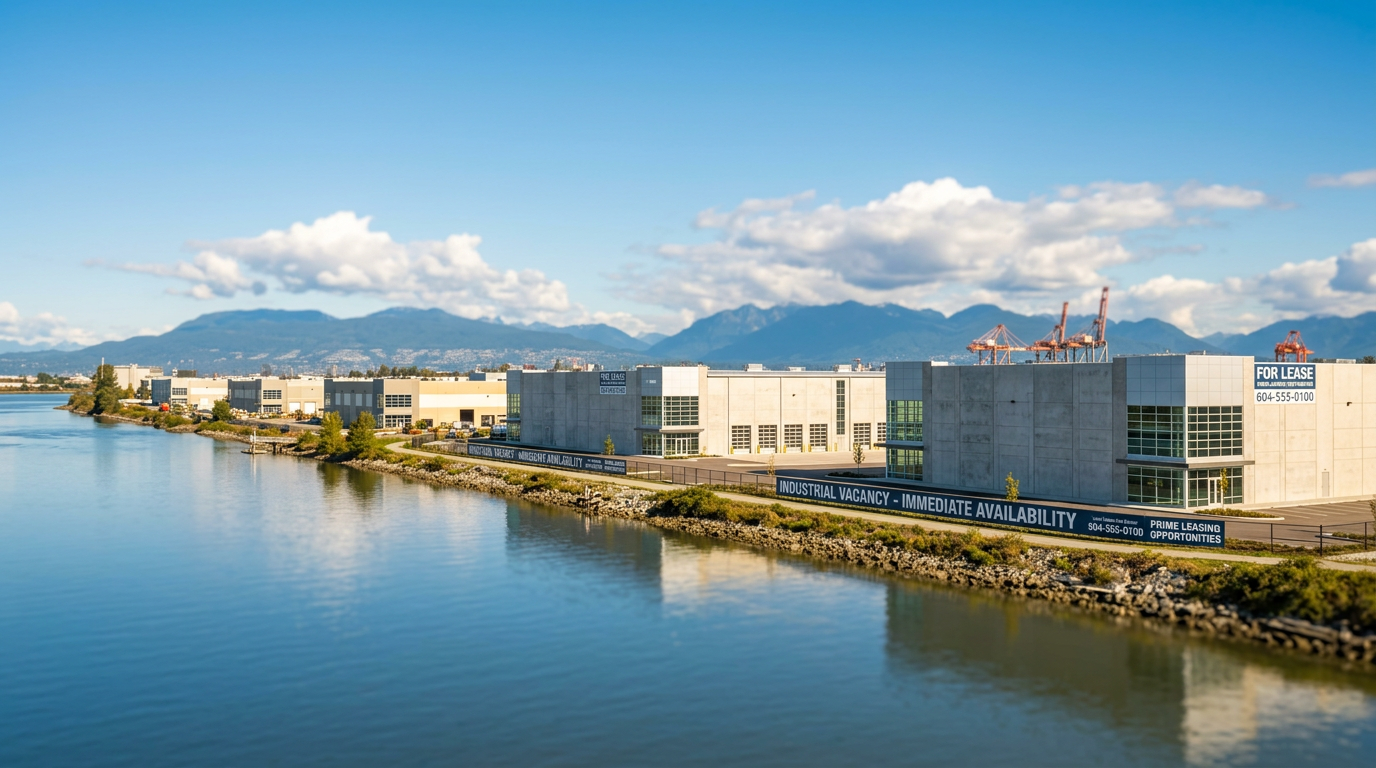
Walk the industrial corridors off Bridgeport Road on any given Tuesday morning and you will notice something unfamiliar: vacancy signs. While not widespread, they mark a genuine shift in a submarket that has been, for the better part of five years, nearly impossible to enter at a reasonable price. Richmond's industrial market — the engine room of Metro Vancouver's cold-chain, e-commerce fulfilment, and airport logistics ecosystem — is softening for the first time since 2020, and investors who have been circling from the sidelines are starting to move.
The data confirms this trend. Metro Vancouver's overall industrial vacancy rate climbed to approximately 4.2% in Q4 2025, according to CBRE, up from the historic low of 1.1% recorded in 2022. That four-year tightening cycle locked out an entire generation of would-be tenants and buyers. Richmond, which accounts for roughly 20% of Metro Vancouver's total industrial inventory by square footage, is now leading the correction, with vacancy reaching levels not seen since the pre-pandemic baseline.
The structural drivers are clear. A wave of speculative industrial supply that broke ground during the 2021–2023 rent boom is now completing, adding square footage to a market where some logistics tenants are consolidating footprints in response to higher occupancy costs and shifting e-commerce patterns. The result is a supply-demand reset — likely temporary, but significant for those with capital ready to deploy.
Richmond’s submarket is distinct due to the quality of available space. It sits at the intersection of three sectors with durable, long-term demand: YVR-adjacent air cargo, temperature-controlled cold-chain distribution, and last-mile e-commerce fulfilment. Vancouver Fraser Port Authority cargo data points to sustained throughput growth that underpins demand for the premium logistics space Richmond offers. This is not a submarket losing its relevance; it is one catching its breath after an extraordinary run.
Asking rents reflect this nuance. Despite rising vacancy, average net industrial asking rents across Metro Vancouver remain elevated at $18 to $22 per square foot. While landlords have not capitulated on pricing, negotiating leverage has shifted. Tenants and buyers who spent years competing in blind bidding situations are finding, for the first time in a long cycle, that they have room to negotiate.
For operators in cold-chain, specialty food, and pharmaceutical logistics, the calculus is straightforward: secure space now before the next demand cycle absorbs the new supply. Richmond's proximity to YVR, the George Massey Tunnel corridor, and its established cold-storage infrastructure are not replicable. Colliers International's BC industrial data has consistently flagged Richmond's limited developable land base as a long-term supply constraint, suggesting today's vacancy is a cyclical blip rather than a structural shift.
For investors, the opportunity is equally compelling. Cap rates on Metro Vancouver industrial assets have expanded modestly, offering the first genuine yield improvement in years. Well-located Richmond assets — particularly those with cold-chain infrastructure or direct YVR connectivity — are likely to see compression again as the supply cycle works through. Richmond's Economic Development Office has long positioned the city's industrial land base as a strategic regional asset, and that fundamentals-based outlook remains.
The bottom line: The uptick in Richmond's industrial vacancy is a correction in a market that required one. For operators priced out since 2020 and investors who watched cap rates compress to near-irrelevance, the next six to twelve months represent the most accessible entry window in half a decade. The structural demand drivers — YVR logistics, cold-chain, and e-commerce — remain intact. The competition for space has temporarily eased, and that gap is where opportunity lives.
Watch for: Q1 2026 absorption data from CBRE and Colliers, expected in April, will indicate whether the vacancy plateau is holding or beginning to reverse.



