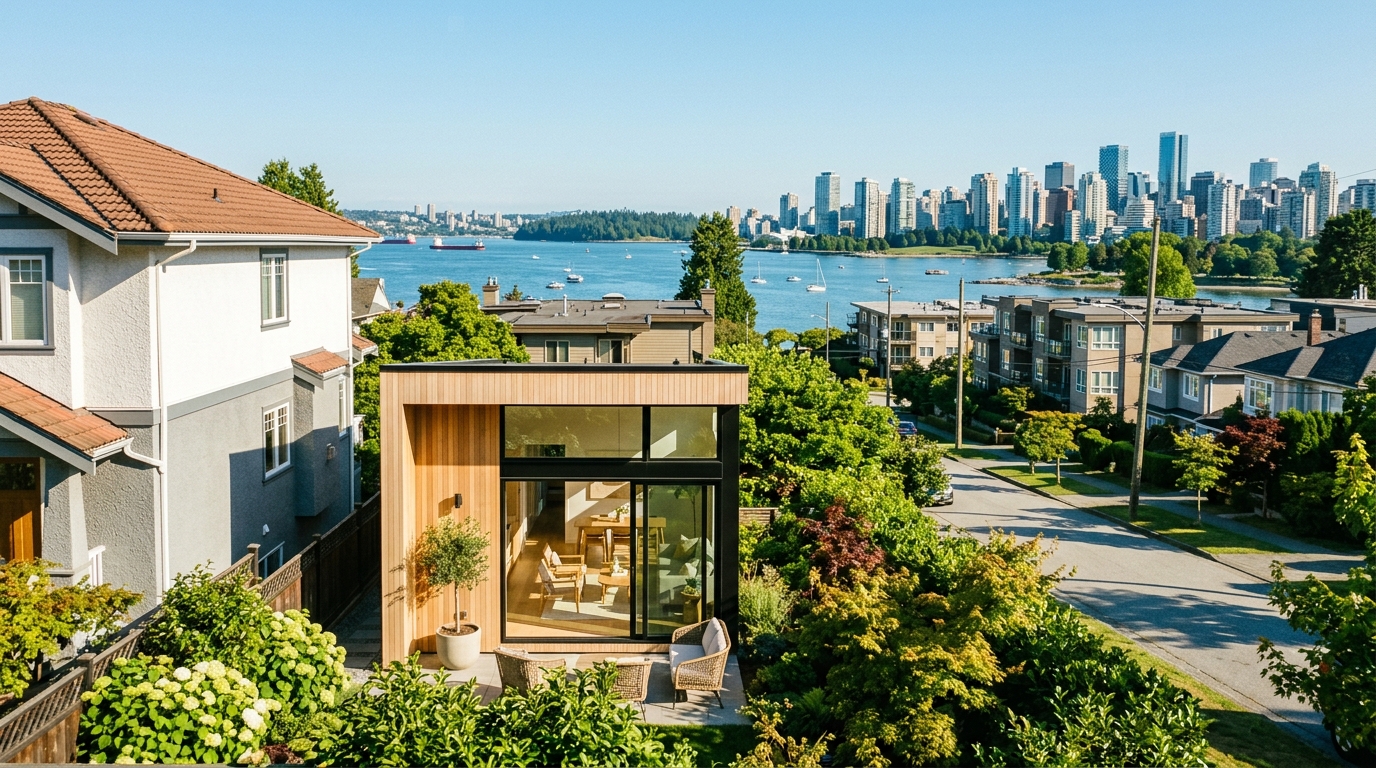
The permit is framed on the kitchen table. The architect's drawings are approved. The contractor is ready. What is missing, for a growing number of Metro Vancouver homeowners, is the construction loan—and without it, a laneway home that could house a family remains a set of blueprints.
This is the quiet failure at the centre of BC's housing supply story. Bill 44, which came into force in late 2023, was a policy breakthrough, mandating small-scale, multi-unit housing permissions across the province and theoretically unlocking secondary suite and accessory dwelling unit (ADU) potential on an estimated 1.1 million lots. The zoning barriers that had restricted infill housing for decades were, in one legislative stroke, removed.
However, zoning permission is not the same as a built home. The gap between the two is widening.
Data from Canada Mortgage and Housing Corporation shows ADU completions in Metro Vancouver running at roughly 30 per cent of permitted volumes—meaning that for every ten laneway homes or secondary suites that receive a permit, only three are built. The structural reason, according to industry analysts, is a financing methodology that has not kept pace with the zoning reform it is intended to support.
The core problem is that conventional lenders—the Big Six banks and most credit unions—assess construction loan eligibility using appraisal models designed for single-family homes. When a homeowner applies to finance a laneway home or basement suite addition, the lender appraises the property as it currently sits, not as it will function as a multi-unit income property. The projected rental income from the new unit—the very income that makes the project financially viable—is often excluded from the appraisal or deeply discounted.
Average laneway home construction costs in Metro Vancouver run between $280,000 and $420,000. For a homeowner with $800,000 in equity, that sounds manageable—until the lender's appraisal ignores the rental income potential and the available loan-to-value headroom fails to cover the build. Refinancing the primary mortgage to extract construction capital often hits the same wall: the appraised value of the finished multi-unit property does not reflect what the market would pay for it.
City of Vancouver Development and Building Services data on permit-to-completion ratios underscores the scale of the gap. Vancouver has been among the most active municipalities for ADU permit issuance since Bill 44 passed, but completions have not followed at the same rate, a pattern consistent with a financing bottleneck rather than a demand or design problem.
Mortgage Professionals Canada has flagged the appraisal methodology mismatch in member surveys, noting that lenders lack standardized income-capitalization frameworks for small-scale multi-unit residential properties. Unlike purpose-built rental buildings, which are appraised on an income approach, a single-family home with a new laneway unit falls into an awkward middle category: too small for commercial lending desks, yet too complex for residential underwriting teams.
The opportunity in that gap is significant. Metro Vancouver's rental vacancy rate remains critically low, and ADUs represent one of the fastest potential sources of new supply. The Urban Development Institute has identified the ADU pipeline as a contributor to medium-term supply projections, contingent on financing solutions that do not yet exist at scale.
Some lenders are beginning to move. A small number of BC credit unions and alternative mortgage investment corporations have been piloting ADU-specific construction products that incorporate projected rental income into the qualification model. These products remain niche, with higher rates and shorter amortization periods than conventional construction loans, but they represent an attempt to close the methodology gap.
The federal government's CMHC Housing Supply Challenge has also directed funding toward financing innovation, with several applicants proposing ADU-specific underwriting frameworks. Whether those frameworks reach mainstream lenders will determine if these pilot programs scale into a market shift.
For homeowners, the practical advice from brokers is to engage a mortgage professional with specific ADU experience before finalizing construction budgets, and to model scenarios under both conventional and alternative financing terms. The rate premium on alternative products—often 1.5 to 2.5 percentage points above prime—can be partially offset by rental income once the unit is occupied, but the carrying cost during construction requires careful cash-flow planning.
The bottom line: Bill 44 solved the zoning problem. The financing problem remains the binding constraint on Metro Vancouver's ADU supply pipeline. The lender that builds a scalable, income-capitalization-based ADU construction product first will capture a market that BC's housing policy has spent two years creating.
What to watch: CMHC's Housing Supply Challenge results, expected later in 2026, will signal whether federal backing is coming for ADU-specific underwriting tools. Watch also for BC credit union regulatory guidance on income-property appraisal standards for small-scale multi-unit residential—a policy lever that could move faster than new legislation.



