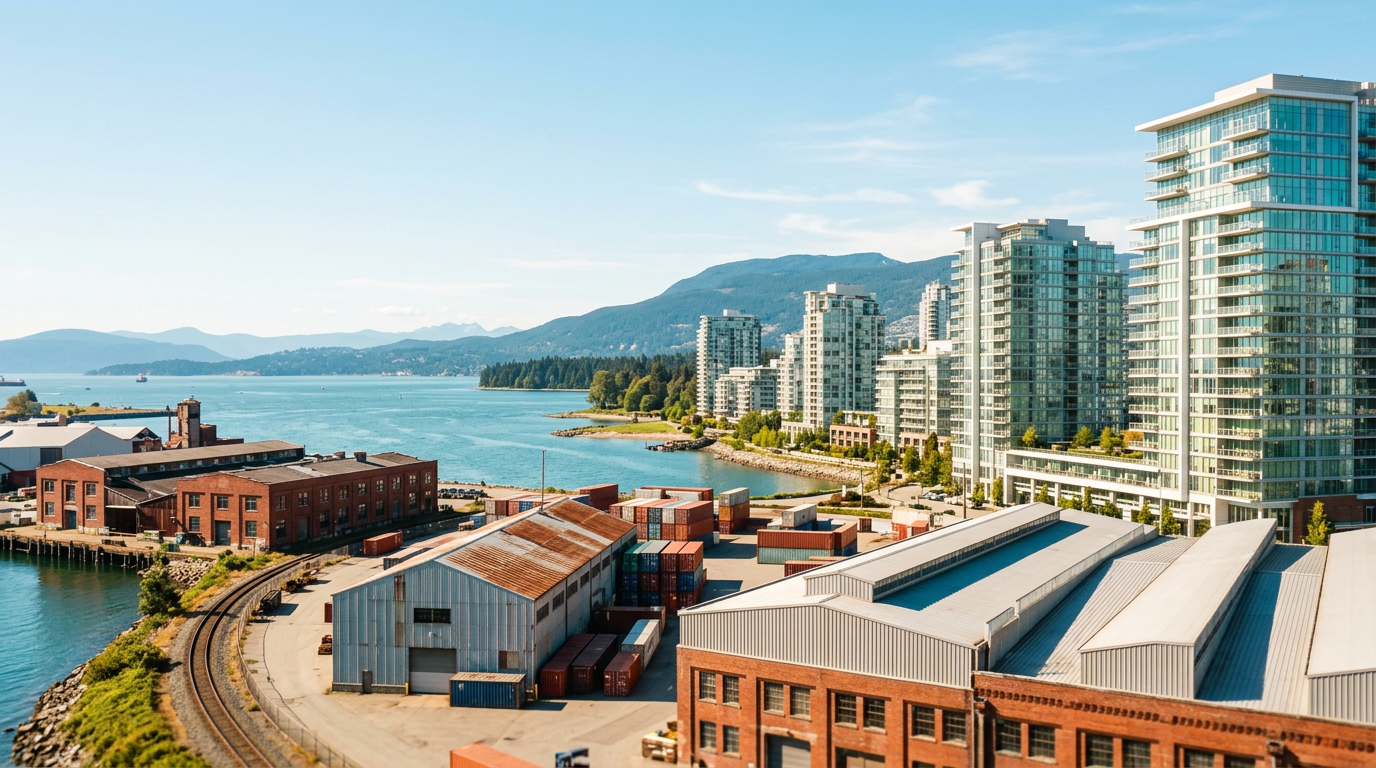
On a block of Prior Street where a metal fabricator has operated for two decades, the future is suddenly under negotiation. A rezoning application filed with the City of Vancouver in late 2025 proposes converting industrial parcels to mixed-use—ground-floor retail or light commercial beneath residential towers. For the landowner, the math is transformative. For the fabricator paying below-market industrial rent, the math is existential.
This tension defines the current state of Strathcona, one of Vancouver's last genuinely mixed industrial neighbourhoods. A wave of rezoning applications filed in Q4 2025 and Q1 2026 is moving through the City of Vancouver's Development & Building Services office. For operators, neighbours, and investors, the window to participate is closing; several applications are already at the public hearing stage, with comment periods measured in weeks.
The Uplift Equation
For landowners, the numbers are compelling. Industrial-zoned land in the East Vancouver corridor has historically traded at a discount to residential or mixed-use land. When a parcel is rezoned, that gap—the uplift—flows to the landowner. In Metro Vancouver's constrained market, that uplift can represent millions of dollars per parcel.
Scarcity drives this dynamic. Metro Vancouver's 2022 Industrial Land Inventory identified approximately 11,300 hectares of industrial land across the region. Once this land is rezoned, it is effectively removed from the industrial supply permanently. This irreversibility makes the current cluster of applications a strategic inflection point.
For landlords, the decision is complex. While rezoning unlocks value, it also requires navigating a City process that increasingly demands community benefit agreements, affordable housing, and employment space provisions. The Urban Development Institute BC notes that these requirements have evolved significantly over the past three years.
The Displacement Pressure
The opportunity for landowners is a threat to tenants. Strathcona hosts a concentration of light-industrial users—fabricators, food processors, and small logistics operators—many of whom rely on long-term leases at rates that do not reflect rising land values. When a rezoning application succeeds, these leases typically do not survive redevelopment.
The Strathcona Business Improvement Association has highlighted the cumulative effect of this pressure, noting that the neighbourhood’s industrial character supports a workforce that cannot easily relocate to suburban business parks. Data previously compiled by the Vancouver Economic Commission (which ceased operations in 2023) underscored that urban industrial jobs often pay above median wages and remain accessible to workers without post-secondary credentials.
With regional industrial vacancy remaining below two per cent, displaced operators face a hostile relocation market with limited availability.
What the Applications Actually Say
The current applications sit near the future Great Northern Way–Emily Carr SkyTrain station. Transit proximity is central to the rezoning rationale; the City's Broadway Plan and East Vancouver zoning review identifies transit-adjacent industrial land as suitable for mixed-use conversion, provided employment uses are retained.
Whether "employment at grade" results in functional industrial space or boutique retail depends on conditions attached at the public hearing stage—such as ceiling heights and loading requirements. Operators have standing to influence these outcomes, provided they participate in the process.
The Bottom Line
The Strathcona rezoning wave is an ongoing process with distinct action items:
For landowners and investors: Properties in the rezoning corridor are at a strategic decision point. While the uplift potential is significant, community benefit obligations are increasingly stringent. The City of Vancouver's Development & Building Services portal lists active applications and hearing dates.
For industrial operators: Understanding your rights before an application is approved is critical. Participating in public hearings—individually or through the Strathcona BIA—is the most direct lever available to ensure replacement space is functional.
For the neighbourhood: Each parcel converted represents a permanent subtraction from a finite supply of industrial land. The current hearing process is effectively determining the future of Vancouver’s industrial capacity, block by block.
Public hearing dates for active Strathcona rezoning applications are listed on the City of Vancouver's public hearing schedule.



