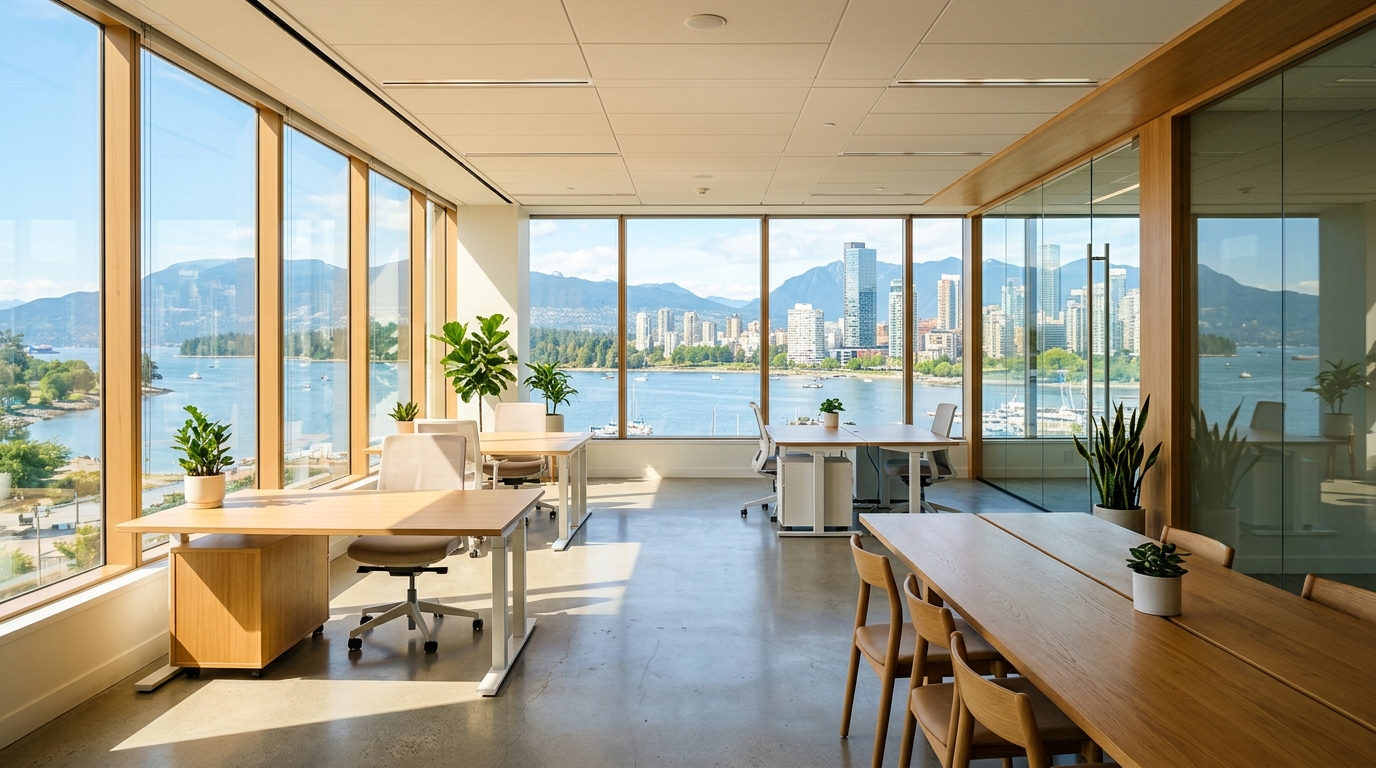
Picture a fully fitted-out floor on Broadway—standing desks, boardroom glass, a server room already wired—sitting at roughly two-thirds the price of the unit next door. That is not a hypothetical. It is the current state of Metro Vancouver's Class A sublease market, and for the right firm, it may be the most favourable office-leasing environment in half a decade.
According to Colliers International's sublease availability tracker, Metro Vancouver's Class A sublease inventory reached approximately 1.8 million square feet in Q1 2026—the highest level recorded since 2021. The driver is clear: a sharp contraction in Vancouver's tech sector. Companies that locked in large, premium floors during the 2021–2023 expansion cycle are now shedding space they no longer need, acting quickly before their own lease obligations compound.
The result is a secondary market with characteristics rarely seen in Vancouver real estate: genuine urgency on the supply side. Sublessors are motivated. They are paying rent on empty desks every month their space sits vacant, which means negotiating leverage has shifted decisively toward tenants.
The Numbers That Matter
CBRE's Q2 2026 Vancouver office market report puts sublease rates in the Broadway Corridor at 20–35% below direct asking rents for comparable Class A space. On a 5,000-square-foot floor—a comfortable fit for a 30-to-40-person professional services firm—that discount can translate to $80,000 to $140,000 in annual savings depending on the building and lease term. Over a three-year sublease, the arithmetic becomes transformative for a firm managing tight margins or deploying capital into headcount rather than overhead.
Beyond the rate discount, sublease space carries a second, underappreciated advantage: it arrives furnished and fitted. Tech tenants who built out their spaces during the post-pandemic boom invested heavily in millwork, acoustic panels, collaborative zones, and technology infrastructure. A growing law firm or scale-up startup inheriting that environment avoids a fit-out cost that, in today's construction market, can run $80 to $120 per square foot for a quality finish. On a mid-size floor, that is another $400,000 to $600,000 that stays on the balance sheet.
Where the Inventory Is
The two most active sublease corridors are downtown Vancouver—particularly the blocks between Burrard and Granville, where several high-profile tech tenants have listed contiguous floors—and the Broadway Corridor from Cambie to Arbutus, which absorbed significant tech expansion during the years when the Broadway SkyTrain extension was under construction. JLL Canada's Metro Vancouver office data shows the downtown core accounting for roughly 60% of current sublease listings by square footage, with the Broadway Corridor representing the bulk of the remainder.
Transit access remains a key asset in both corridors. The Millennium Line Broadway Extension, slated for completion in 2027, is expected to enhance connectivity between the corridor and the rest of the region, making Broadway sublease space increasingly competitive with Class A downtown product for firms whose staff commute from the east side, Burnaby, and the Tri-Cities.
The Clock Is Ticking
Sublease inventory expires. When a sublessor's head lease ends—typically in two to four years—that space reverts to the landlord and re-enters the market at direct rates. The current surplus will not be replenished at the same scale once this cycle of tech contraction runs its course.
Avison Young's Vancouver office team has flagged that the window for the most favourable sublease terms is likely concentrated in the next 12 to 18 months, as the earliest-listed spaces begin to attract competing interest and the broader market absorbs available inventory. Firms that move in H2 2026 will have more choices and more leverage than those who wait until 2027.
For mid-market firms—the 20-to-80-person professional services shops, the Series A and B startups, and the regional offices of national firms—the strategic calculus is worth running now. The question is not whether sublease space is cheaper, but whether the specific space, term length, and sublease assignment conditions align with your growth trajectory. Sublease agreements carry their own complexity: assignment clauses, head landlord consent requirements, and the risk that a sublessor's financial distress creates disruption. Legal review of the head lease is non-negotiable before signing.
The Bottom Line
Metro Vancouver's Class A sublease market is offering a rare combination: premium address, premium fit-out, and below-market rates. For firms that have been priced out of Broadway or downtown Class A product, or that have been making do with Class B space while they scaled, this is the window. The inventory is real, the discounts are real, and the infrastructure is already in place. What is not guaranteed is how long any of it lasts.
Watch for: sublease absorption rates in Q3 reporting from CBRE and Colliers; any signal that tech hiring is recovering, which would slow new sublease listings; and landlord responses, as some building owners are beginning to offer direct lease incentives to compete with their own sublessors.



