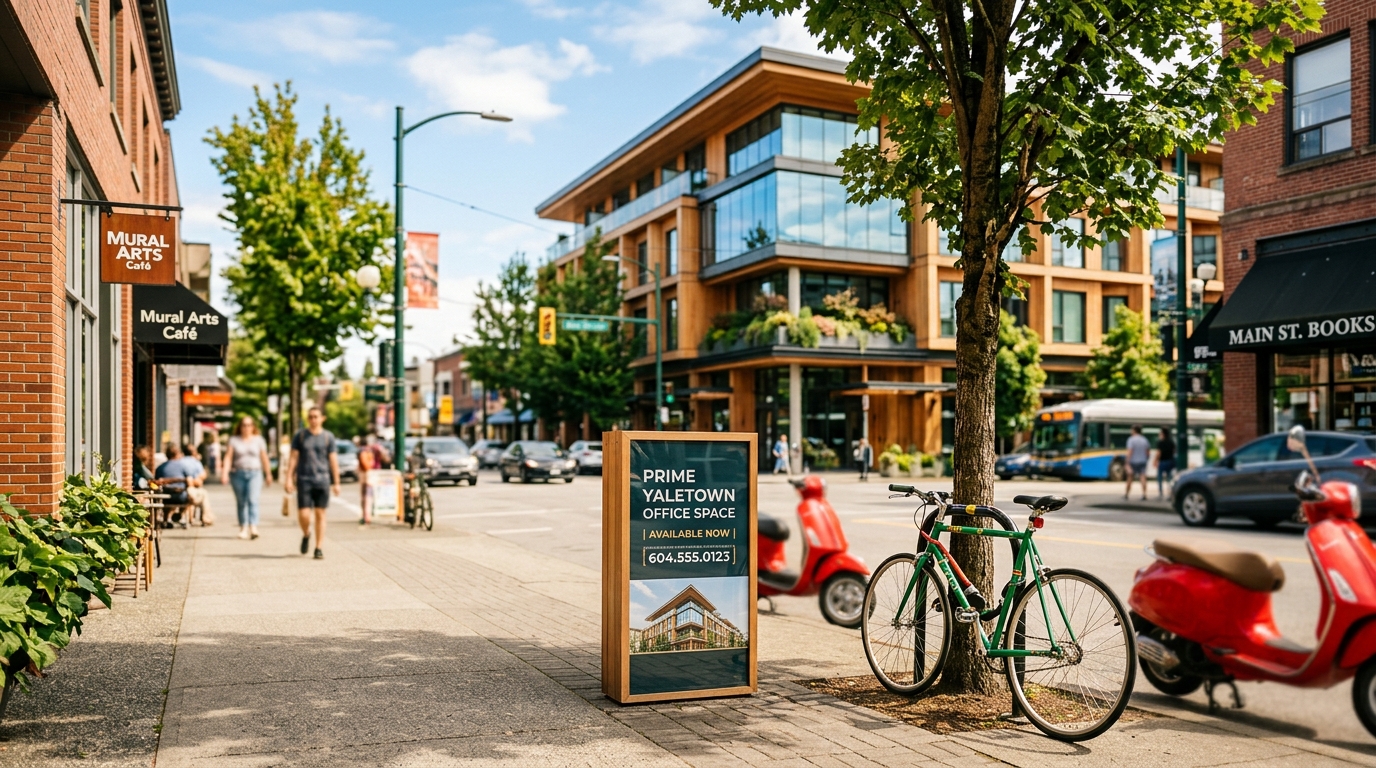
Walk through Yaletown on a Tuesday afternoon and the neighbourhood still hums with activity. But step into the elevator banks of the low-rise brick-and-beam buildings that define the district and you will find something that has not existed since before the pandemic: For Sublease signs on doors that, two years ago, carried waiting lists.
A significant volume of sublease inventory has accumulated across Yaletown and Mount Pleasant as tech and media companies that over-hired and over-leased during the 2021–2022 expansion cycle now right-size their footprints. According to CBRE's Q1 2026 Vancouver Office MarketView, sublease availability across Metro Vancouver's urban submarkets has risen sharply year-over-year, with Yaletown and Mount Pleasant among the most affected corridors. The Colliers Vancouver office sublease tracker similarly flags both neighbourhoods as carrying elevated sublease-to-direct vacancy ratios—a signal that the space hitting the market is coming from tenants, not landlords.
That distinction matters significantly to any firm currently hunting for space.
What Makes Sublease Different
Direct leases are negotiated against a landlord's interest: longer terms, higher face rents, and fitout timelines that can push occupancy 12 months out. Subleases flip that dynamic. The sublandlord—typically a tech firm with 18 to 36 months left on its head lease—needs the space off its books and is willing to deal. According to Colliers' Vancouver sublease market data, subtenants are currently securing space at discounts ranging from 15 to 30 per cent below comparable direct-lease asking rents in the same buildings.
In practical terms, a firm that would have paid $38 to $42 per square foot annually on a direct lease in a Mount Pleasant creative-office building can negotiate a sublease in the same corridor for $28 to $34—rates that brokers describe as broadly equivalent to 2019 pricing. On a 5,000-square-foot suite, that gap represents $50,000 to $70,000 in annual savings, before factoring in the furnished fitouts and installed technology infrastructure that many sublandlords are leaving behind.
As noted in Avison Young's Metro Vancouver sublease commentary, these spaces are often move-in ready, complete with workstations, boardrooms, and AV systems. For a firm that would otherwise spend six months and $500,000 on a fitout, the financial calculation is compelling.
Remaining terms on current listings are running an average of 18 to 30 months, providing enough operational stability for firms to plan while avoiding the decade-long commitments that can stifle growth.
Where the Inventory Is
Yaletown's sublease concentration is heaviest in the 1,500 to 6,000 square foot range—the sweet spot for professional services firms, scale-ups, and mid-sized non-profits. The neighbourhood's heritage brick-and-beam stock, which commands a premium in direct-lease markets, is well represented.
Mount Pleasant's sublease inventory skews slightly larger, with several listings in the 6,000 to 15,000 square foot range reflecting the bigger floorplates of newer purpose-built creative office buildings along the Main Street and Broadway corridors. The neighbourhood's proximity to the Broadway SkyTrain extension adds a transit premium that makes these subleases especially attractive for firms recruiting talent from across the region.
BOMA BC occupancy data for Metro Vancouver's urban core confirms that overall office utilization remains below pre-pandemic norms, but the sublease dynamic is distinct from general vacancy: this is high-quality, amenitized space in desirable neighbourhoods, not dated Class B stock in peripheral locations.
The Decision Calculus for Growing Firms
The firms best positioned to act are those with lease events—renewals, expansions, or expirations—coming due in the next 12 to 24 months. Waiting until the second half of the year to begin the search is a risk: sublease inventory, unlike direct vacancy, absorbs quickly once tenants recognize the value gap. The best-positioned listings—furnished, transit-proximate, in heritage or newer Class A buildings—are already drawing multiple inquiries.
For non-profits and mission-driven organizations, the sublease window carries particular significance. Premium Yaletown and Mount Pleasant addresses that were effectively inaccessible at direct-lease pricing are now within reach on operating budgets that have not scaled with the commercial market.
Scale-ups in professional services, technology, and creative industries face a different but equally compelling calculus: locking in below-market space now preserves capital for hiring and product development, while the shorter sublease term provides optionality if growth accelerates faster than anticipated.
Market Snapshot: Yaletown and Mount Pleasant Sublease
- Sublease discount vs. direct asking rents: 15–30% (Colliers Vancouver data)
- Typical suite size available: 1,500–15,000 sq ft depending on submarket
- Average remaining term: 18–30 months on current listings
- Fitout status: Majority of listings are furnished or partially furnished
- Transit access: Both submarkets served by Broadway SkyTrain corridor
The Bottom Line
The sublease surge in Yaletown and Mount Pleasant is not a crisis story; it is a market correction that has created a genuine, time-limited opportunity for firms agile enough to recognize it. Tech's contraction is professional services' and the non-profit sector's gain. The space is premium, the pricing is 2019-equivalent, and the terms are flexible. Firms with lease events on the horizon should be in conversations with tenant-rep brokers this month.



