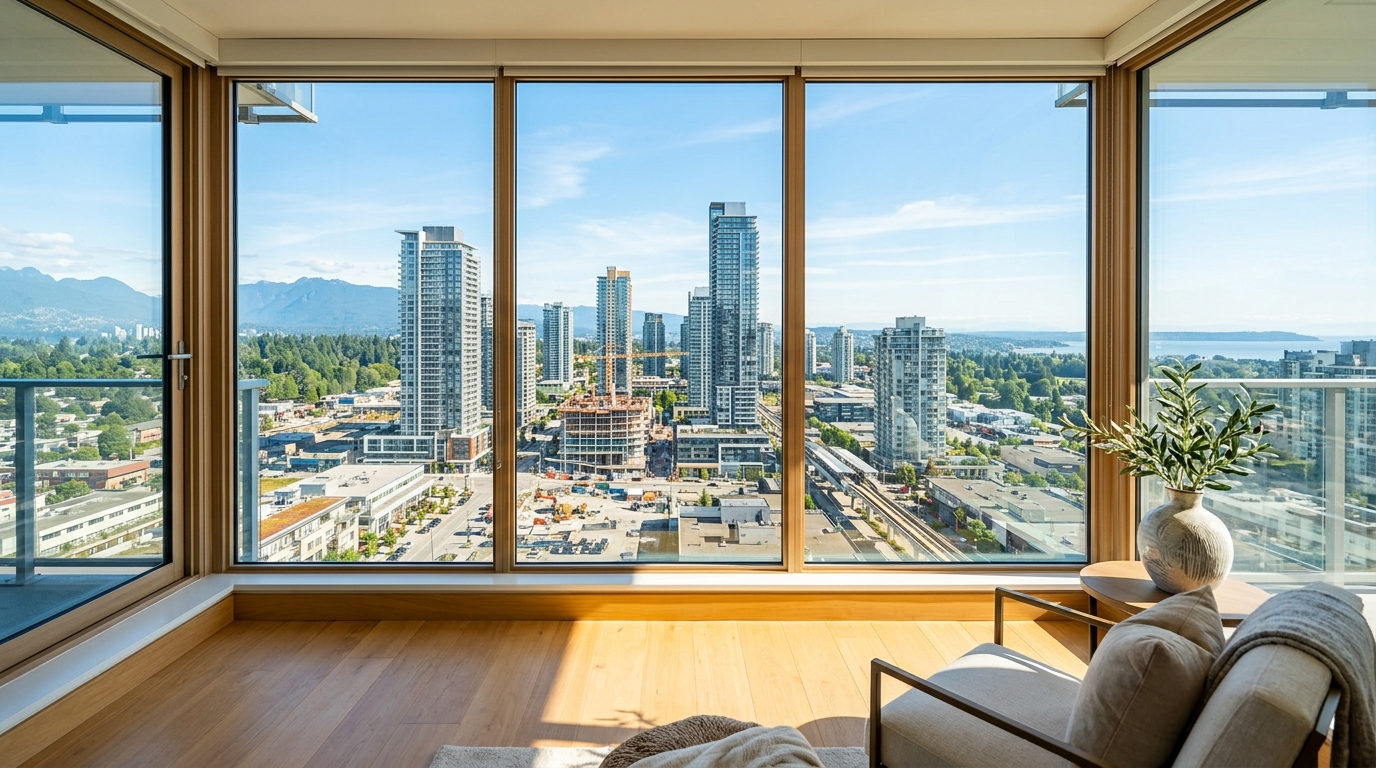
Stand at the corner of 104 Avenue and King George Boulevard on a weekday morning and you will see what Surrey's boosters have described for years—and what the market is only now beginning to price in. The King George SkyTrain station hums with commuters. A cluster of mixed-use towers frames the skyline to the north. Between them, a ring of underperforming office and retail buildings sits on land that is being repositioned through rezoning applications, pre-application meetings, and land assemblies that have not yet made headlines.
Surrey City Centre is in the early stages of a structural repricing—the kind that rewards those who move before the consensus catches up.
The catalyst is a wave of rezoning applications advancing through the City of Surrey's development portal that would permit the conversion and intensification of underperforming office and retail assets into mixed-use residential towers. The municipal permitting velocity Surrey has built over the past three years is compressing timelines that would take considerably longer in Vancouver or Burnaby.
The demographic case is straightforward. Metro Vancouver's Regional Growth Strategy projects Surrey will surpass Vancouver in population by the mid-2030s, making it BC's largest city within a decade. Surrey's population is younger, faster-growing, and increasingly employment-dense as major institutions, including Simon Fraser University's Surrey campus and Surrey Memorial Hospital's expanding footprint, anchor the City Centre core.
Land cost differentials tell the most immediate story for investors. BC Assessment data shows City Centre land trading at a meaningful discount to comparable transit-oriented sites in Burnaby's Metrotown and Brentwood corridors. The gap has historically reflected a perception of Surrey as a secondary market; that perception is eroding, but the pricing has not yet fully followed.
The office-to-residential conversion economics add another layer. Industry commentary from local developers places the hard construction cost premium for conversion over greenfield construction at roughly 15 to 25 per cent, driven by structural retrofitting, mechanical upgrades, and irregular floorplates. In Surrey City Centre, that premium is partially offset by lower land basis and the density uplift that rezoning approvals unlock. A site acquired at office-use land values and rezoned for a 40-plus-storey mixed-use tower represents a fundamentally different return profile.
Submarket reports from major commercial brokerages have tracked Surrey City Centre's office vacancy at elevated levels relative to pre-pandemic norms—a condition that accelerates rezoning momentum. Assets that cannot lease at viable rates become candidates for conversion, and owners become motivated sellers.
SkyTrain ridership is the infrastructure anchor that makes the density case coherent. TransLink ridership data places King George and Surrey Central among the higher-volume stations on the Expo Line. Every rezoning that adds residential density to the City Centre core increases ridership, which in turn strengthens the case for further transit investment.
The Surrey Board of Trade has consistently advocated for accelerating the City Centre transformation, framing density and mixed-use conversion as an economic competitiveness strategy that attracts employers and retains young professionals.
For investors still treating Surrey as a secondary consideration, the question is not whether City Centre will reprice, but whether they will be positioned before or after it does. The rezoning pipeline is clearing, the population trajectory is firm, and the land cost differential remains a compelling entry point.
The bottom line: Surrey City Centre is an early-consensus position in a market where fundamentals have outpaced pricing. Office-to-mixed-use conversions, density uplift, and strong demographic tailwinds are converging in a submarket that still carries a discount to Burnaby and Vancouver. That discount has a shorter shelf life than many investors currently assume.
What to watch: The City of Surrey's next quarterly development applications update; TransLink's 2026 ridership report for Expo Line station volumes; BC Assessment's July 2026 preliminary roll data for City Centre parcels; and any pre-application activity filed by major Metro Vancouver development groups in the 104 Avenue and King George corridor.



