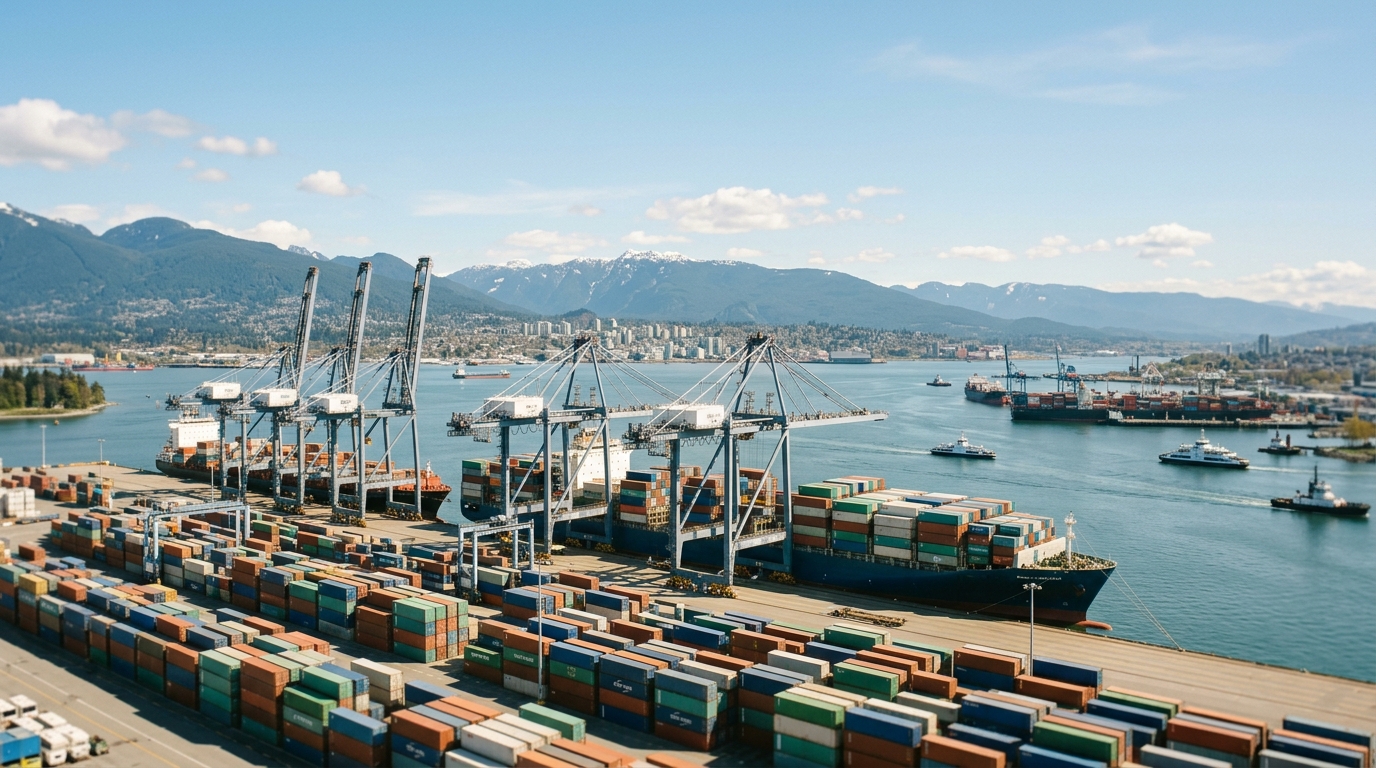
For BC exporters, the defining metric of 2026 is clear: approximately 55 cents of every dollar earned from merchandise exports in 2025 went to the United States. With U.S. tariffs on Canadian goods remaining elevated, that concentration is no longer a strength—it is a structural vulnerability. Exporters who act now to diversify will secure a durable cost advantage, while those who wait risk finding the best alternative channels already claimed.
The scale of the exposure
BC's export economy generated roughly $49 billion in goods in 2025, spanning softwood lumber, seafood, clean-tech components, and manufactured goods. The U.S. market absorbed the largest share by far. Now, with compounded duties on BC softwood lumber exceeding 20% in the U.S. and Canada's own 25% counter-tariff on U.S. goods in effect as of April 2026, the economics of that dependency have shifted materially.
The business community's response is measurable. According to the Export Development Canada Q1 2026 Trade Confidence Index, 15 to 20% of BC exporters have initiated formal market diversification plans since January 2026—a rapid pace of adjustment for an industry not typically known for quick pivots. The question is no longer whether diversification is happening, but whether your competitors are moving faster.
Where the capital is flowing
The primary destination for redirected BC export flows is the Asia-Pacific region—specifically Japan, South Korea, Vietnam, and, for select commodities, India. Trade and Invest BC reports indicate sustained demand growth in Japan and South Korea for engineered wood products, seafood, and clean-energy components.
For the softwood lumber sector, the arithmetic is increasingly compelling. While Asian markets require longer shipping times and upfront logistics investment, the absence of compounded anti-dumping and countervailing duties means net realisations can approach or exceed U.S. pricing. The Business Council of British Columbia's 'New Arithmetic of Trade' briefing highlights this margin dynamic, noting that the duty wedge effectively subsidises the cost of establishing new distribution infrastructure.
Clean-tech component manufacturers are finding receptive markets in South Korea and Japan, where domestic decarbonisation mandates drive procurement. The overlap between BC's clean electricity advantage and Asian industrial buyers' sustainability requirements is creating genuine commercial alignment.
The mechanics of arbitrage
The strategy is straightforward: exporters are renegotiating supply contracts to shift duty exposure, routing shipments through third-country distribution hubs, and restructuring value-added processing to qualify for preferential tariff schedules under the Comprehensive and Progressive Agreement for Trans-Pacific Partnership (CPTPP).
The CPTPP acts as a structural enabler, providing BC exporters with preferential access to Japan, Vietnam, Malaysia, and other signatories. Because the treaty requires specific rules of origin, some manufacturers are adjusting their input sourcing to maximise CPTPP eligibility, which has downstream implications for BC's supplier ecosystem.
The competitive cost of waiting
If you run a BC company that sells primarily into the U.S., a cohort of your competitors is currently investing in freight relationships, market development, and contract renegotiation to establish footholds in new regions. While the upfront cost is significant, exporters who absorb it in 2026 will operate from a structurally lower cost base if U.S. tariffs persist, and from a more resilient position if they ease. The cost of waiting is the price of arriving second to markets where shelf space and distributor relationships are finite.
Canadian Manufacturers and Exporters' BC chapter is directing members toward federal and provincial market-development support programmes, including EDC financing instruments designed for exporters opening new geographic channels. Programme timelines are critical; the companies that have already submitted applications are weeks ahead of those still assessing their options.
What this means for Vancouver
The current tariff disruption acts as an accelerant for the diversification that BC's export economy required regardless of U.S. trade policy. An economy that sends more than half its goods to a single market is inherently exposed to policy shifts and demand cycles. The exporters building Asian distribution channels today are not merely managing a tariff problem; they are building more durable businesses. The window to secure these positions is a matter of months, not years.



