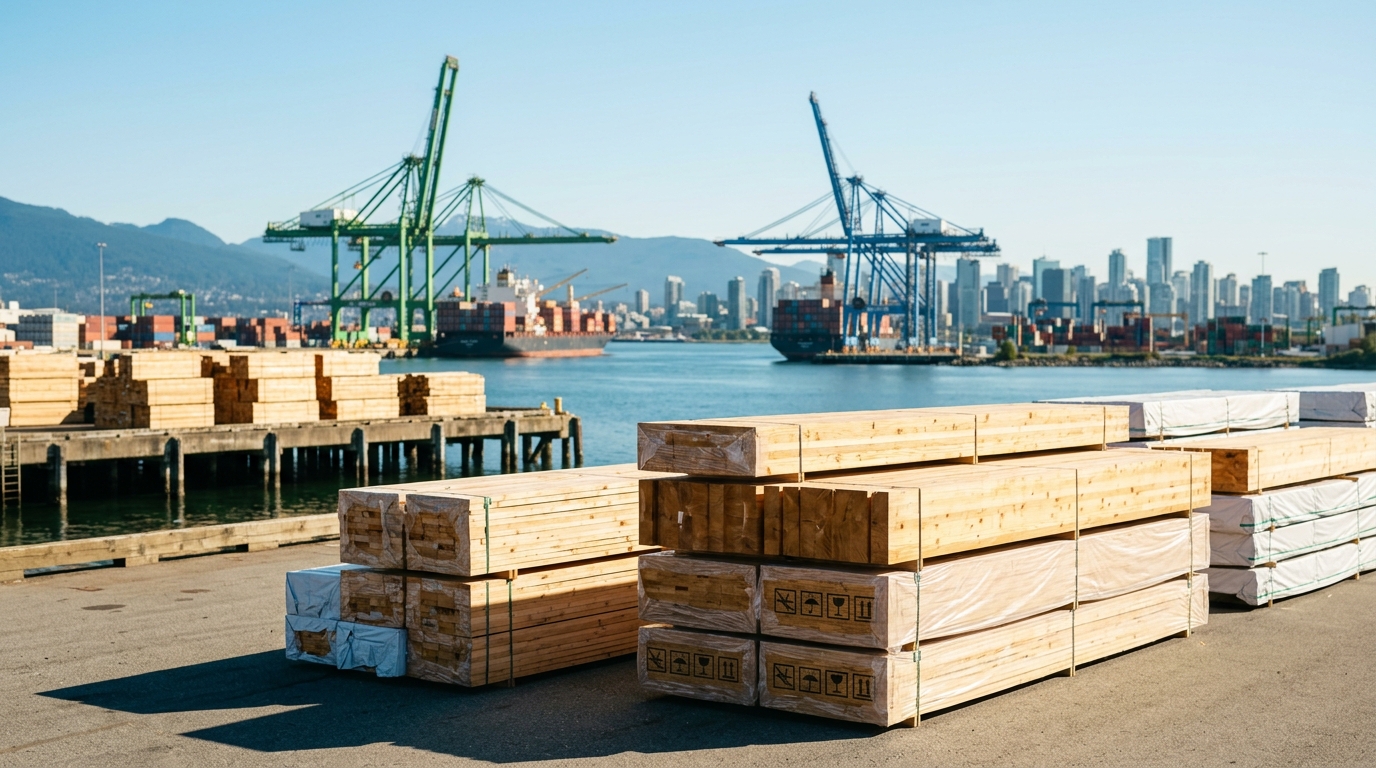
The headline number is painful: combined U.S. countervailing and antidumping duties on Canadian softwood lumber now exceed 14 per cent. For BC’s commodity mill operators—the producers of dimensional lumber that frames houses from Kelowna to Kansas City—the renewed tariff pressure arrives at a difficult moment for an industry already operating on thin margins.
However, a gap in the tariff structure is reshaping the flow of forestry capital. Mass timber and engineered wood products—such as cross-laminated timber (CLT), glulam beams, and laminated veneer lumber—face a materially lower effective duty rate under existing U.S. trade classifications. Because these products are classified differently from commodity softwood lumber in U.S. customs schedules, they remain largely outside the scope of the orders impacting dimensional boards. For BC producers in this segment, the current tariff regime acts as a tailwind.
The commodity squeeze
BC’s forestry sector exports approximately $4.5 billion worth of softwood lumber to the United States annually, making it the province’s largest goods export to that market. The BC Council of Forest Industries has documented the cumulative toll of successive duty rounds: higher stumpage fees, rising energy and labour costs, and a freshened tariff burden erode viability at mills lacking the scale or product mix to absorb the hit. Operators producing commodity two-by-fours, which serve as the backbone of BC’s interior forestry communities, face the highest exposure.
The engineered-wood opening
BC’s mass timber manufacturers are navigating a different environment. U.S. demand for CLT and glulam is accelerating, driven by embodied-carbon targets in American building codes, a mass timber construction market projected to grow at double-digit compound annual rates through 2030, and a growing cohort of American developers prioritizing low-carbon construction.
BC is well-positioned to serve this demand. The province has invested in manufacturing capacity, and the Wood First Act has integrated mass timber into BC’s construction pipeline, creating the domestic volume necessary to build the scale and certification credentials American buyers require.
Strategic implications
For capital allocators, the bifurcation is clear. The investment thesis for commodity milling remains challenged by structural cost pressures and trade friction. Conversely, the thesis for engineered wood has strengthened: lower tariff barriers, accelerating U.S. demand, and alignment with provincial policy create a convergence of commercial opportunity and public-interest goals.
The cost implications for Metro Vancouver construction are also notable. As commodity lumber prices reflect the tariff burden, BC builders may see a modest near-term benefit on dimensional lumber costs, even as engineered wood commands a premium. The net effect on project economics will depend on product mix and build type.
Ultimately, the forestry sector’s challenge is divided. Knowing which side of the tariff line a business occupies is now a critical strategic question. Companies that move up the value chain will be better positioned regardless of how future trade negotiations evolve.



