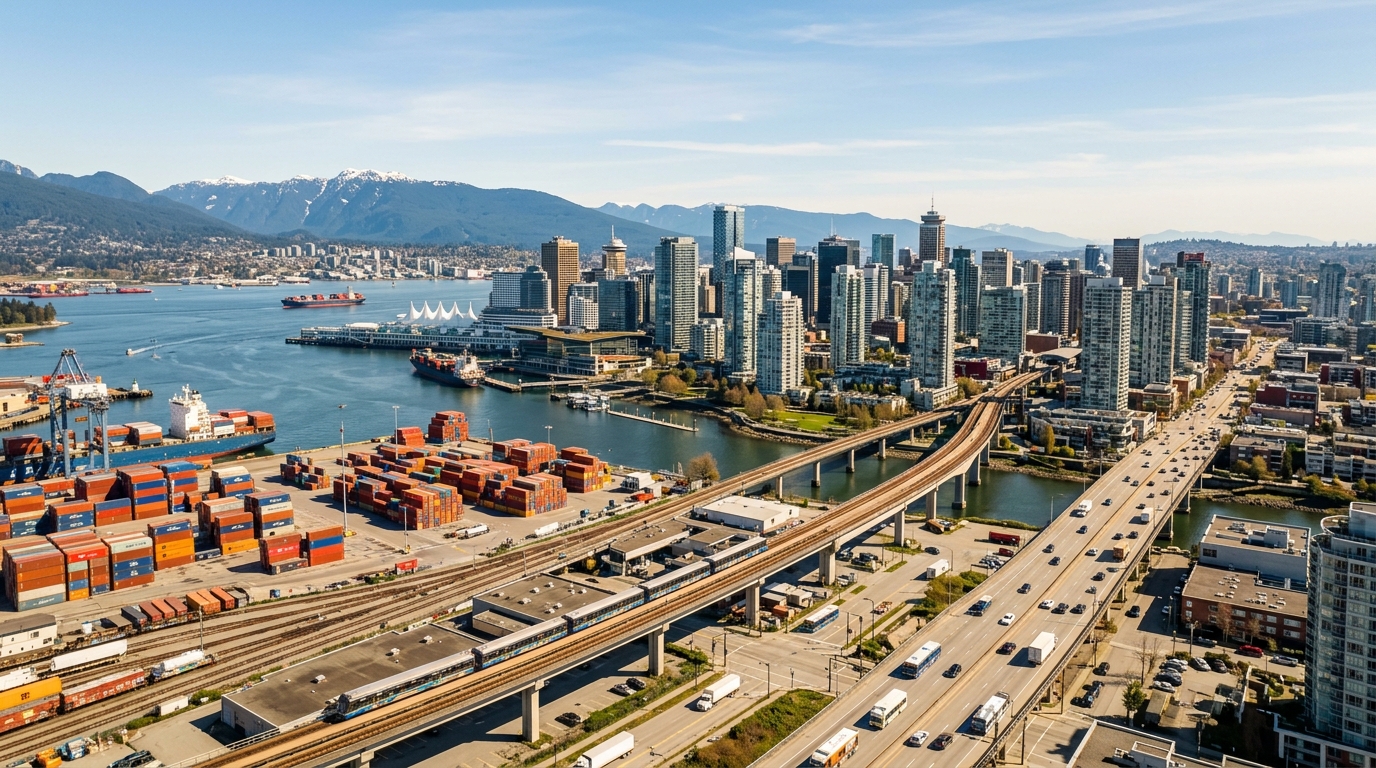
Every major location decision a Metro Vancouver developer, logistics operator, or employer makes in the next ten years rests on a single question that no one can currently answer with confidence: which transit corridors will actually get built?
TransLink's 2026–2035 Investment Plan carries an estimated $26 billion in capital requirements—a figure that dwarfs previous regional transit commitments and arrives at a difficult moment for public financing. Ottawa is managing significant spending obligations, while Victoria is navigating a projected deficit of approximately $4.2 billion. Metro Vancouver's mayors must now determine whether to support a regional property tax levy to bridge the shortfall—a move with direct consequences for land values from Langley to North Vancouver.
Transit access remains the primary driver of commercial and residential land values in Metro Vancouver. Corridors that secure funding within the next 36 months will likely see accelerated land appreciation and developer interest. Conversely, corridors that face deferral will wait—and in a market where industrial land along the Fraser Valley corridor is already commanding rents above $20 per square foot, delays carry a measurable financial cost.
The Funding Gap
TransLink requires $26 billion over ten years. The three traditional funding partners—Ottawa, Victoria, and Metro Vancouver municipalities—face constraints absent during the last major expansion cycle. Historically, the federal government contributed roughly one-third of major transit capital costs. If that formula holds, Ottawa's share would reach $8–9 billion. However, recent signals from the Canada Infrastructure Bank suggest project-by-project negotiation will define this cycle rather than formula-based transfers.
The largest line item is the SkyTrain Expo Line extension to Langley, with cost estimates now at approximately $6 billion. That project alone consumes a significant portion of any realistic federal allocation, leaving other corridors to compete for the remainder.
Project Positioning
Projects with completed environmental assessments, land acquisition, and existing federal letters of intent are better positioned to proceed. The Broadway Subway extension to Arbutus is already under construction and effectively locked in.
The Surrey-Langley SkyTrain corridor is the primary focus for commercial real estate operators. Industrial and mixed-use land along the Fraser Highway has been priced, in part, on the assumption that grade-separated rapid transit arrives within a decade. If the extension is delayed, land values in those micro-markets face repricing risks. Meanwhile, the 104 Avenue corridor is slated for Bus Rapid Transit (BRT), which is not grade-separated.
By contrast, commercial corridors already served by the Millennium Line—including Brentwood, Lougheed, and Coquitlam Centre—are insulated from this funding uncertainty. Their infrastructure is complete, and the development premium is already established.
The Property Tax Lever
The most consequential near-term decision rests with Metro Vancouver's Board of Directors, which is weighing a regional property tax levy to backstop the shortfall. While the mechanism exists under the South Coast British Columbia Transportation Authority Act, it requires consensus among mayors representing diverse constituencies. A levy sufficient to close the gap would likely increase commercial property tax bills—a challenge for landlords in a market with elevated office vacancy rates.
Strategic Outlook
For developers and investors, the funding uncertainty creates a distinct decision window. Land along proposed corridors—particularly the Langley extension and potential North Shore transit study areas—is currently priced at a discount to its post-construction potential. Operators with a five-to-ten-year horizon are effectively being offered an option on transit-oriented density at pre-announcement prices.
For logistics operators, the calculus is different. If the Langley extension is delayed, pressure on Fraser Valley industrial land will intensify. Employers making office location decisions should note that the Broadway corridor remains the most stable option, given that construction is already underway.
The next six months will likely determine which projects survive the funding negotiation. Federal project approvals through the Canada Infrastructure Bank and BC Ministry of Transportation capital estimates will serve as key indicators of actual commitment. Operators should treat this funding gap as the central variable in their site selection models.



