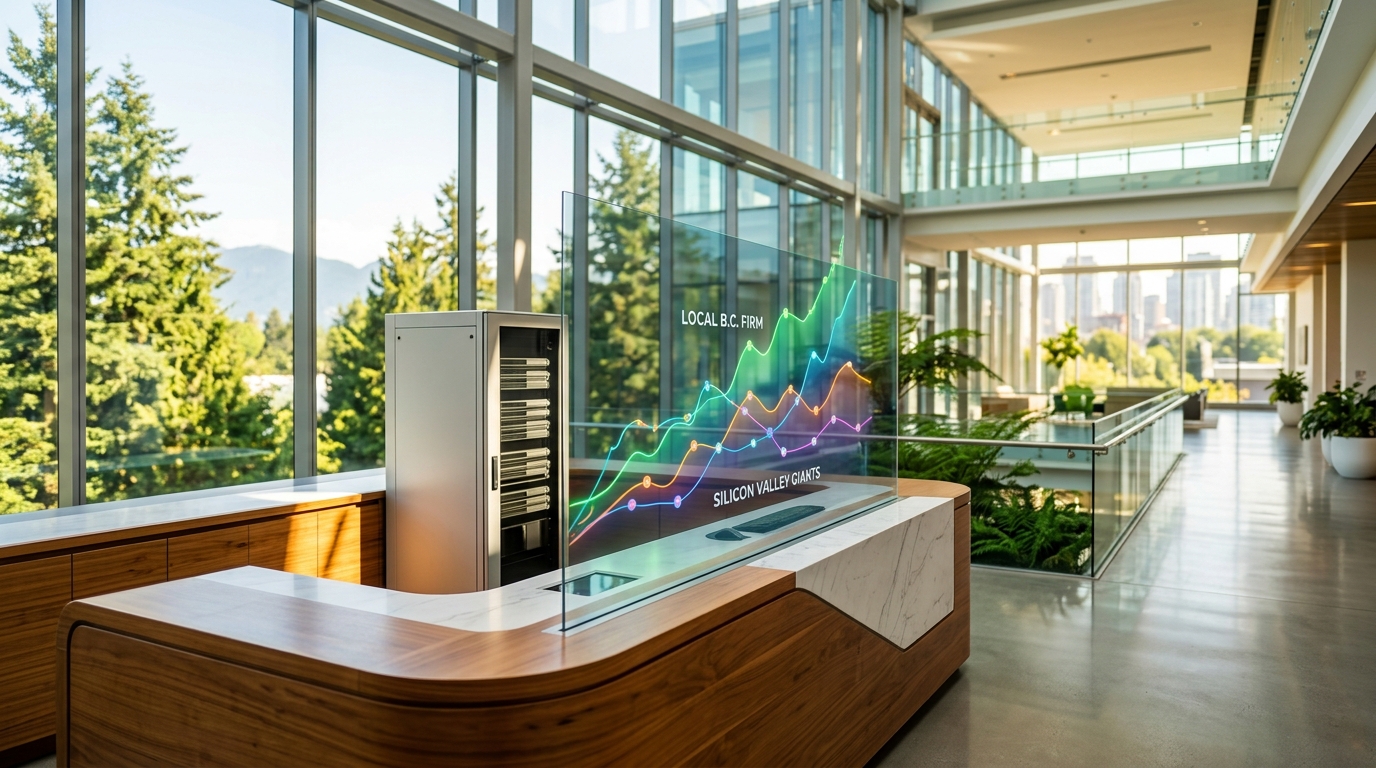
Forget the data centre arms race. The most compelling AI infrastructure story in Metro Vancouver isn't about pouring concrete or negotiating megawatts from BC Hydro. It is about the software and services layer sitting between foundation models and enterprise deployment—and Vancouver has quietly assembled the ingredients for a genuine cluster.
At least two Vancouver-based AI infrastructure companies closed seed rounds in Q2 2026, according to Canadian venture capital deal tracking. Both are hiring aggressively, with open roles concentrated in MLOps engineering, inference systems, and enterprise sales—a hiring pattern that mirrors what the Metro Vancouver AI talent market has signalled for several quarters.
GPU compute costs have fallen roughly 40% year-over-year as H100 supply normalized, lowering the barrier for startups in the inference layer that do not need to own hardware to build a defensible business. The opportunity lies in optimization, orchestration, and compliance, rather than capital expenditure.
Canada's Personal Information Protection and Electronic Documents Act, combined with the forthcoming Bill C-27 framework, creates a structural data residency advantage for Canadian operators serving regulated industries. Financial services, healthcare, and government agencies operating under Canadian privacy law increasingly require inference workloads to be processed on Canadian soil. Vancouver operators are positioned to serve both Canadian enterprises and U.S. companies with Canadian data obligations—a cross-border advantage that pure-play American infrastructure providers cannot easily replicate.
The talent density argument is quantifiable. Metro Vancouver hosts an estimated 2,400-plus machine learning and AI practitioners, a concentration built over two decades through UBC's computer science and statistics programs, local engineering offices for global tech firms, and the gravitational pull of the visual effects industry, which trained a generation of engineers in GPU-accelerated computing.
Vancouver sits within a two-hour flight of Seattle—home to AWS, Microsoft Azure, and a dense ecosystem of AI-native companies—and within the same time zone as major U.S. West Coast hyperscalers. For Canadian operators building integration layers, that proximity is a significant asset for enterprise sales and partnership negotiations.
The BC Tech Association's sector mapping has identified AI infrastructure as an emerging cluster, and Innovate BC's funding recipients in the 2025–2026 cohort include several companies working on inference optimization and MLOps. The Creative Destruction Lab's Vancouver stream has also supported AI infrastructure companies, providing access to institutional validators and U.S. enterprise networks.
For investors, the "picks-and-shovels" framing requires precision. Defensible positions are emerging in compliance-aware inference orchestration, fine-tuning pipelines for regulated data, and observability tooling for production ML systems—areas where switching costs are high and the sales motion aligns with enterprise procurement. CVCA deal data for Q1–Q2 2026 suggests Canadian venture capital is beginning to follow this thesis, with AI infrastructure attracting a growing share of early-stage funding relative to application-layer AI.
The hyperscale data centre story is a supply-side challenge measured in gigawatts and years. The infrastructure software story is measured in engineering months and compliance frameworks. Vancouver has the talent and the regulatory context to lead in the latter. The seed rounds closing now are the early signal; the question is whether follow-on capital and enterprise traction arrive fast enough to establish a durable, permanent geography.