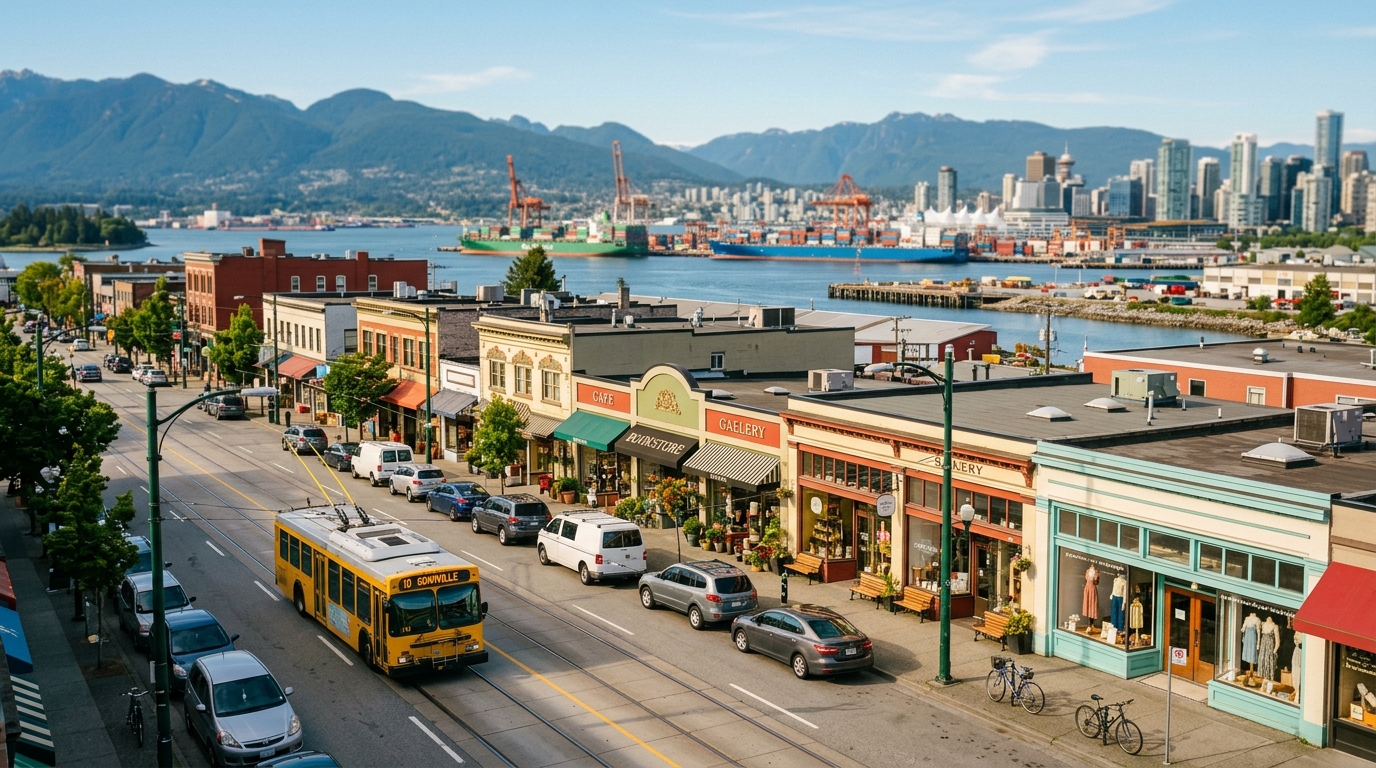
Walk along Commercial Drive on a Tuesday morning and you will notice something that did not exist three years ago: a cluster of storefronts that are occupied, buzzing, and clearly not running on traditional retail economics. One space hosts a rotating ceramics studio. Another is a pop-up grocery anchored by a local food collective. A third has been converted, temporarily, into a neighbourhood job-training centre. None of these tenants signed a five-year lease; most signed agreements measured in weeks.
This is what commercial street activation looks like in 2026, and Vancouver's Business Improvement Areas (BIAs) are the institutions driving the change.
Across the city's secondary retail corridors, BIAs have spent the past two years building a new operating model for neighbourhood commercial health. The toolkit includes short-term licensing frameworks that allow landlords to place tenants without triggering long-term liability, artist-in-residence programs that use creative occupancy to maintain foot traffic, and City of Vancouver Vacant Storefront Registry data that BIAs now use to map vacancy patterns and target interventions with precision.
Commercial vacancy on Vancouver's secondary corridors has shifted in character. The post-pandemic adjustment, combined with sustained pressure from rising assessed values and the structural retreat of mid-market retail, has left corridors like Hastings-Sunrise and parts of Kerrisdale with a different kind of vacancy than the 2010s produced. These are not spaces waiting for the right national chain; they are spaces that the conventional leasing market—with its preference for creditworthy tenants, long terms, and personal guarantees—simply cannot fill at current rents.
The City of Vancouver's Vacant Storefront Registry, which tracks ground-floor commercial vacancies, has become a foundational tool for BIAs trying to understand the shape of this problem at the block level. Vacancy rates vary sharply by corridor: streets that lose a key anchor—a grocery, a pharmacy, or a café cluster—can tip into self-reinforcing vacancy cycles where empty windows suppress foot traffic, which in turn suppresses new tenant interest.
Traditional BIA tools, such as street beautification and marketing campaigns, address symptoms without touching the underlying economics. The new generation of activation programs aims to change those economics directly.
The most consequential innovation is a standardized short-term commercial licensing framework. This framework provides landlords with a legally clear, administratively simple pathway to place a tenant for 30, 60, or 90 days without the paperwork burden of a conventional lease and without creating tenancy rights that complicate future leasing decisions.
For landlords sitting on vacant space, the calculus is straightforward: a short-term tenant covers operating costs, maintains the physical condition of the space, and keeps the storefront active, which protects the value of neighbouring units. For prospective tenants, many of them early-stage neighbourhood businesses, the framework offers a chance to test a location before committing to a long-term lease.
The Hastings-Sunrise BIA has been among the most active practitioners of this model, working with property owners along the Hastings corridor to place tenants in spaces that had been dark for months. The Commercial Drive BIA has taken a parallel approach, pairing short-term placements with a curated matching process that aligns tenant types with the specific character of each block, prioritizing food, services, and community-facing businesses over uses that generate little pedestrian spillover.
The artist-in-residence programs running in several Vancouver BIAs might look like cultural programming, but the economic logic is pragmatic. An occupied storefront—even one occupied by a working artist—signals activity, draws pedestrians, and maintains the physical fabric of the space. In several cases across the Commercial Drive and Kerrisdale corridors, artist occupancies have served as a bridge: the space stays active, the landlord builds confidence in the activation model, and a commercial tenant eventually moves in.
Perhaps the most significant shift in BIA practice over the past two years is the move toward data-driven decision-making. Several Vancouver BIAs are now using foot-traffic analytics tools—aggregated, anonymized mobile location data—to build block-level pedestrian indices that help prospective tenants underwrite lease risk before signing.
The practical impact is significant. A prospective tenant considering a space on a recovering corridor can now see not just the asking rent but a 24-month foot-traffic trend for that specific block, benchmarked against comparable streets. That data reduces uncertainty, and reduced uncertainty makes tenants more willing to commit, even on corridors that are still rebuilding.
The BIA activation story is, at its core, a story about institutional adaptation. BIAs were created as marketing and beautification vehicles. The ones that are succeeding in 2026 have reinvented themselves as neighbourhood economic development agencies—operating informal incubator programs, brokering short-term commercial tenancies, and deploying data tools that were not part of their mandate five years ago.
For Vancouver's commercial landlords, the message is practical: BIA partnership is no longer just about hanging flower baskets. The BIAs that have built activation infrastructure represent a genuine leasing channel for spaces that the conventional market cannot move.
For the City of Vancouver, the question is whether the informal frameworks BIAs have built deserve formal institutional support—streamlined permitting for short-term commercial use, data-sharing agreements that give BIAs better access to registry information, and potentially direct funding for activation programs that are currently running on thin BIA budgets.
And for the neighbourhoods themselves, the activated storefront is not an abstraction. It is the difference between a street that feels alive and one that does not. That difference shapes where people shop, where they walk, and ultimately where they choose to live and work. The BIAs building this new playbook are, in the most literal sense, building the economic fabric of the city one short-term lease at a time.



