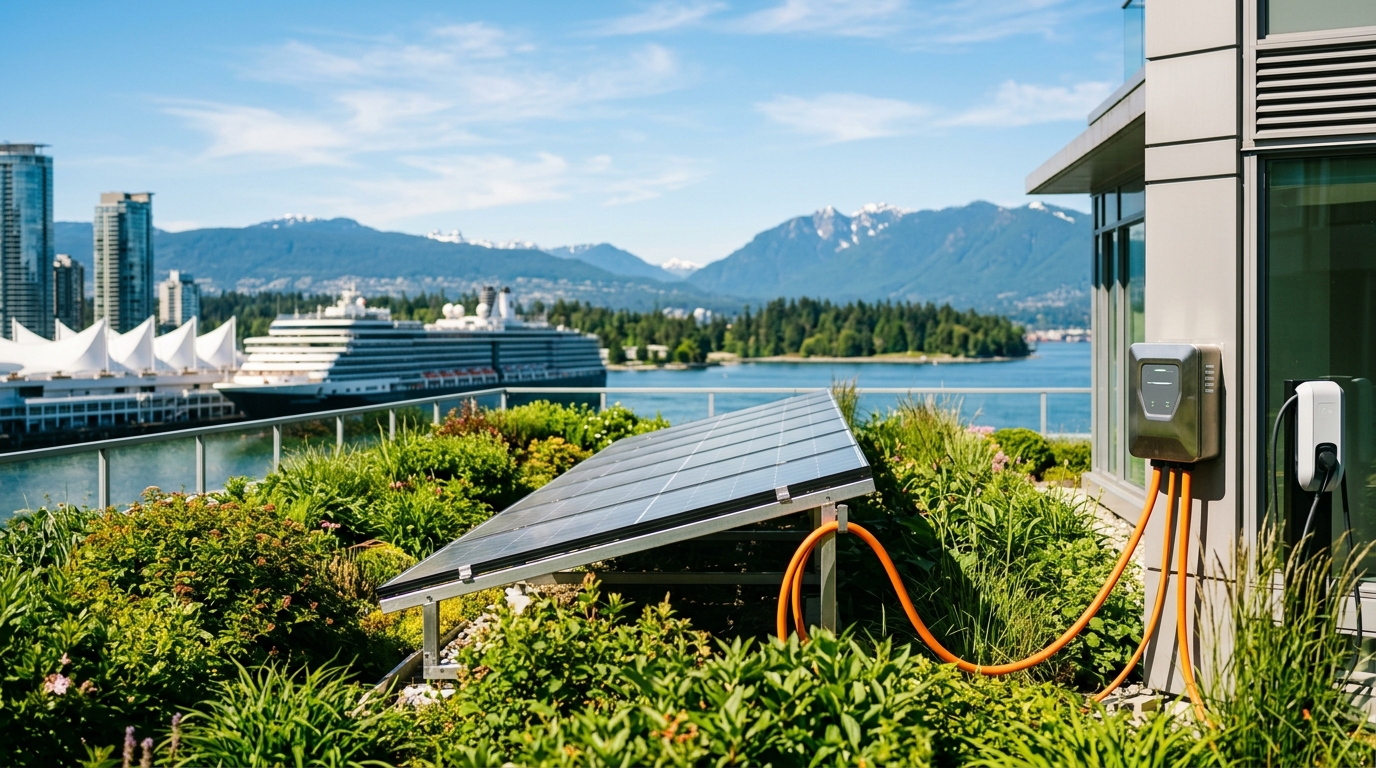
Vancouver's cruise terminals are busy again. The Port of Vancouver is tracking toward approximately 1.3 million passenger embarkations in 2026, a figure that would represent a post-pandemic record and a significant economic event for the hospitality, retail, and transportation sectors. The BC cruise industry contributes an estimated $600 million or more annually to Metro Vancouver's economy, according to industry estimates.
The record season is real. So is the infrastructure challenge running underneath it.
Transport Canada's shore-power mandate requires all vessels calling at major Canadian ports to connect to grid electricity — rather than burning marine diesel at berth — by 2028. The policy is designed to eliminate idling emissions that blanket port communities during turnarounds. At Canada Place and Ballantyne Pier, Vancouver's two primary cruise terminals, the retrofit programme needed to meet that deadline is significantly behind the pace required for on-time compliance. With roughly 18 months of practical construction season remaining before the 2028 window closes, the capital deployment opportunity for BC's electrical contracting and grid-integration sector is immediate and not yet fully priced into project pipelines.
What shore power actually requires
Shore power — technically known as cold ironing or alternative maritime power — involves installing high-voltage electrical connections at berths so that vessels can shut down their auxiliary diesel engines and draw power from the grid while docked. For a modern cruise ship, that load is substantial: a large vessel at berth can draw six to twelve megawatts of power, roughly equivalent to several thousand homes. Multiply that across simultaneous berths at Canada Place, and the grid integration challenge becomes apparent.
The retrofit involves three distinct work packages. The first is the high-voltage shore-side infrastructure: switchgear, transformers, cable management systems, and the physical connection pedestals. The second is grid interconnection: working with BC Hydro to assess and upgrade the transmission capacity feeding the terminals. The third is vessel-side compatibility: ensuring that the cruise lines operating on the Vancouver circuit have the onboard systems required to accept shore power.
Industry benchmarks from comparable North American shore-power installations — including projects completed at the Port of Seattle and the Port of San Francisco — suggest that a full two-terminal retrofit of the scale required at Vancouver could represent $50 million to $150 million in direct infrastructure spend.
The compliance clock
The 2028 deadline carries regulatory weight under Transport Canada's framework, and non-compliance creates direct exposure for terminal operators and the Vancouver Fraser Port Authority. If Vancouver cannot offer shore-power connectivity on the required timeline, cruise lines have an incentive to shift capacity toward Seattle or San Francisco, both of which have more mature shore-power infrastructure. The competitive geography of the Pacific Northwest cruise circuit means Vancouver's berth advantage is partially contingent on its ability to meet the same environmental standards as its American counterparts.
The Vancouver Fraser Port Authority's capital disclosures indicate shore-power infrastructure is a priority investment, but the pace of tendering and construction has not yet matched the urgency implied by the timeline.
Reality check: who is positioned to win the work?
BC's electrical contracting sector has the technical depth for this class of project, but shore-power installations at marine terminals are a specialist submarket. Firms that have worked on BC Hydro interconnection projects, liquefied natural gas terminal electrical systems, or large-scale commercial marine infrastructure are better positioned to move quickly on pre-qualification.
The grid-integration component is particularly demanding. BC Hydro's large-load interconnection process involves capacity studies, potential upstream upgrades, and timelines that can run 18 to 36 months. For the shore-power programme, this means the grid interconnection work is already on the critical path.
The broader economic stake
The shore-power retrofit is an asset-protection investment that safeguards the $600 million annual economic contribution of the cruise industry to Metro Vancouver. A compliance failure would ripple through the hotels that depend on embarkation-day stays, the tour operators who serve arriving passengers, the retail corridors in Gastown and Coal Harbour, and the ground transportation networks that move passengers between the airport and the terminals.