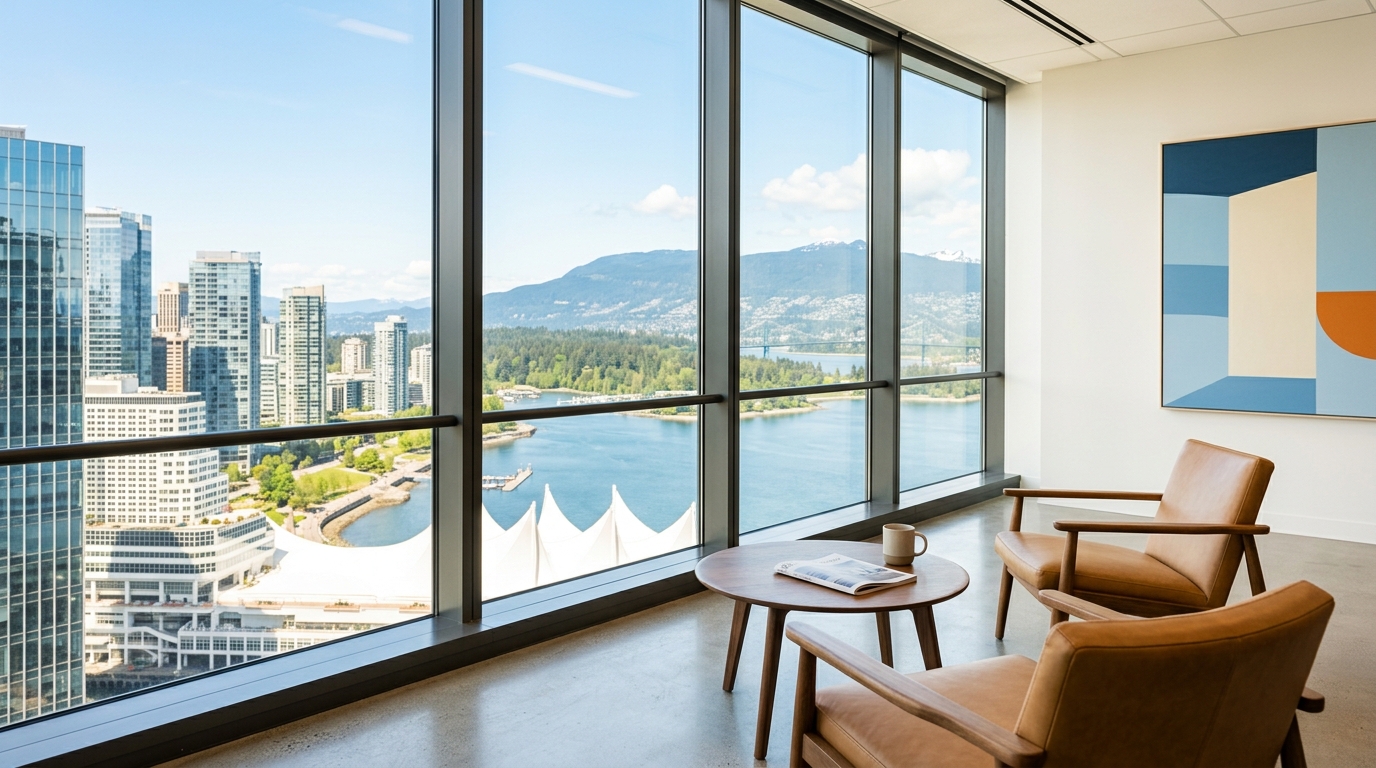
Walk through the lobby of a Class A tower in Coal Harbour on a Tuesday morning and the atmosphere is markedly different from two years ago. The café is full, the security desk is active, and the elevator banks are busy. While it lacks the frenzied pre-pandemic hum, the space is undeniably alive. That shift is backed by data: according to CBRE's Q1 2026 Vancouver Office Market Report, downtown Vancouver's overall office vacancy rate has stabilized in the 11–13% range, marking the first sustained plateau since the pandemic.
The headline figure understates the shift. A more telling indicator is sublease availability—the shadow supply that often signals broader market trends. Sublease space has begun to contract for the first time since 2022, suggesting that companies are either reoccupying their excess square footage or pulling it off the market entirely.
For investors and tenants timing their next move, this reversal is significant.
Where the Recovery Is Leading
Stabilization is not uniform across the city. The clearest growth is concentrated in Coal Harbour and the Central Business District, where Class A buildings with modern floor plates and high-quality amenities are attracting renewed interest from technology and professional services firms. Landlords who invested in building upgrades during the pandemic are now seeing those efforts reflected in absorption numbers.
Conversely, Class B and older Class A stock in secondary locations face a more complex outlook. Structural oversupply persists in these pockets, and tenants with expiring leases retain meaningful negotiating leverage. The bifurcation between premium and commodity office space remains the defining feature of the current market.
How Vancouver Compares
Vancouver’s stabilization appears robust relative to its Canadian peers. Toronto's downtown office vacancy continues to climb, with some estimates exceeding 18% as large financial-sector tenants right-size their footprints. Calgary has seen a sharper decline in vacancy, driven by the energy sector's resurgence and municipal conversion incentives, though it started from a more distressed position. Vancouver's trajectory is more measured, reflecting a market that experienced less volatility and is now seeing a steadier recovery.
The Downtown Vancouver Business Improvement Association reports steady improvements in foot traffic, which correlates with office occupancy. These trends reinforce one another: busier streets enhance the office experience, which in turn drives leasing activity.
The Opportunity Window
For tenants with leases expiring in 2026 or 2027, the current environment likely represents the peak of their negotiating leverage. Landlords continue to offer incentives such as free rent periods and tenant improvement allowances. As vacancy tightens in Class A space, these concessions will likely compress. Tenants who act within the next two to four quarters may secure favourable long-term economics.
For investors, the floor thesis is strengthening. BC Assessment data and transaction evidence suggest that the deepest discounts to replacement cost have likely been realized. While this does not guarantee a sharp rise in values, it suggests that the downside is increasingly bounded. Investors with a five-to-seven-year horizon and a clear strategy for repositioning secondary stock are operating in a unique window.
However, remote and hybrid work have permanently altered space-per-employee ratios. The demand recovery is not a return to 2019, but rather a new equilibrium at a lower absorption rate. Investors should avoid pricing assets based on a return to pre-pandemic density.
The Bottom Line
Vancouver's downtown office market is finding a genuine floor. Sublease supply is shrinking, and premium assets in Coal Harbour and the CBD are seeing steady leasing activity. Because the bifurcation between quality and commodity space is sharpening, the investment thesis must remain asset-specific.
The window for tenants to negotiate from strength and for investors to acquire at distressed pricing is narrower than it was twelve months ago. It remains open, but the clock is running.
Watch for: Q2 2026 leasing data from CBRE and Colliers, expected in July, which will clarify whether the sublease contraction is accelerating and if net absorption has turned positive.



