Consider this: the global aquaculture technology market is projected to exceed USD $3 billion by 2028. Vancouver has a credible claim to a meaningful slice of that market, yet the sector remains largely overlooked.
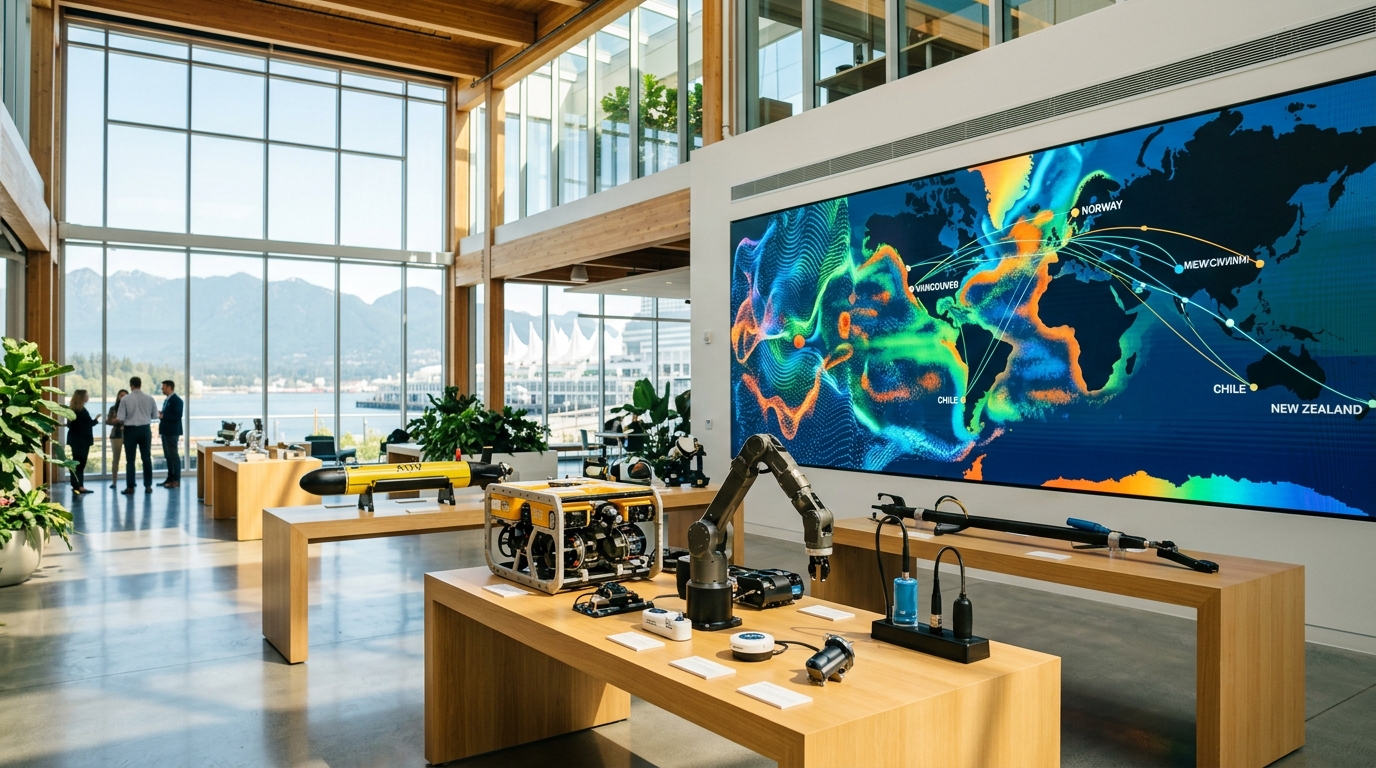
A cluster of Metro Vancouver companies specializing in aquaculture automation, autonomous marine vessels, and ocean-monitoring hardware is building a robust international client base. Contracts in Norway, Chile, and New Zealand are validating locally developed intellectual property. The cluster is small, but it is dense—and it is beginning to operate as a cohesive unit.
Density matters. When engineers, researchers, suppliers, and customers concentrate in one geography, knowledge moves faster. Vancouver’s marine tech scene possesses the essential ingredients: BC accounts for more than 50 per cent of Canada’s total aquaculture output by value, providing local operators with a sophisticated test market and reference customers. This proximity to high-level buyers and deep research infrastructure creates a structural advantage that is difficult to replicate.
The research pipeline runs through UBC’s Institute for the Oceans and Fisheries, one of the most productive ocean science institutions in North America, and through federal initiatives such as the British Columbia Salmon Restoration and Innovation Fund (BCSRIF), which supports technology adoption in commercial fisheries. This combination of federal science infrastructure and university commercialization pipelines produces startups with strong technical foundations—companies that enter the market with peer-reviewed credibility rather than just a pitch deck.
International validation is the real story. Norwegian aquaculture—the world’s largest and most technologically sophisticated—is not an easy market to penetrate. Norwegian fish farmers operate at industrial scale and buy based on performance data. When a Vancouver company lands a contract in the fjords, it is a technical verdict. The same logic applies to Chile, the world’s second-largest salmon producer, and to New Zealand’s marine farming sector, which operates under some of the most demanding environmental compliance regimes in the world.
These export wins are not accidental. Export Development Canada has been actively financing marine tech exports, providing the working capital and risk coverage that allows smaller companies to pursue international contracts. EDC’s involvement signals institutional recognition that this sector is a strategic export play.
On the accelerator side, Foresight Canada’s ocean tech cohort has been building the connective tissue between companies through shared services, co-marketing, and informal knowledge exchange. Innovate BC has also identified marine and ocean tech as a priority sector, which is critical for early-stage capital access.
The cluster breaks into three distinct verticals. Aquaculture automation—including feed management systems, underwater camera networks, and biomass estimation tools—addresses the labour and efficiency pressures facing fish farmers globally. Autonomous vessels reduce the cost and risk of offshore operations, with applications ranging from survey work to environmental monitoring. Ocean-monitoring systems, often built around low-power sensor networks and satellite connectivity, serve offshore energy operators, regulators, and climate researchers.
What unites these verticals is ruggedized hardware. Building electronics that function reliably in saltwater, at depth, and in sub-zero temperatures is a difficult engineering challenge. Vancouver has developed a manufacturing capability for this hardware, supported by a talent pipeline from UBC and BCIT. This manufacturing base is not easily offshored and represents a durable competitive advantage.
For investors, the marine tech cluster presents an unusual profile. These are not high-growth SaaS businesses with 80 per cent gross margins; they are hardware and services companies with longer sales cycles and significant upfront capital requirements. The upside is that once a customer integrates the equipment into daily operations, switching costs are high and contract renewals are often automatic. It is a different kind of moat, but a real one.
The timing is also notable. Global food security pressures are pushing operators to scale aquaculture production faster than the industry’s traditional pace. Environmental monitoring requirements are tightening in every major market, and autonomous vessel technology is reaching commercial viability just as offshore labour costs are rising. All three tailwinds are structural, not cyclical.
Vancouver has built something that took decades to accumulate: fisheries heritage, ocean research infrastructure, ruggedized hardware manufacturing, and a growing roster of companies with international reference customers. The cluster is not yet a household name in the way that Vancouver’s AI or fintech scenes are. That is an opportunity. The companies doing the work are not distracted by hype cycles; they are too busy shipping products to fish farmers in Norway.