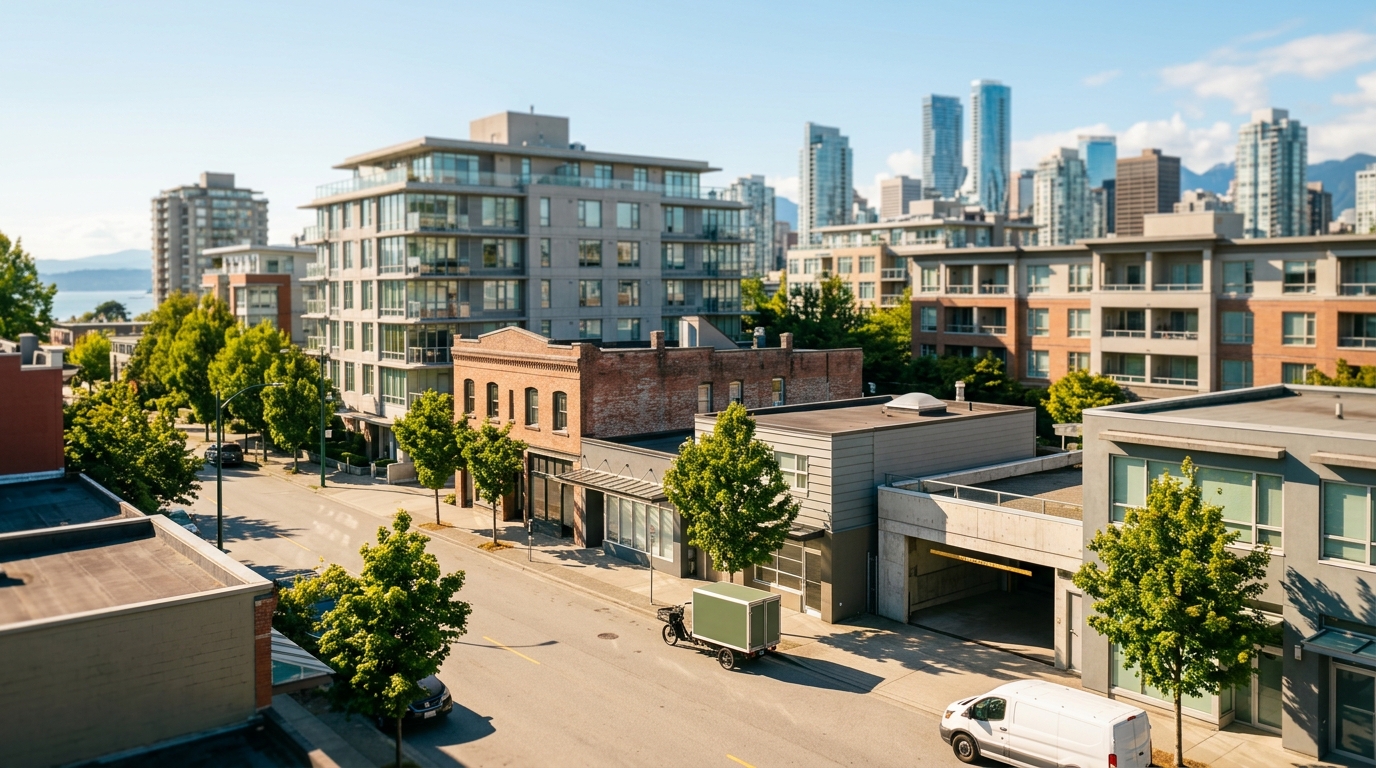
The building doesn't look like a warehouse. It never did. A former ground-floor retail unit in East Vancouver—one of dozens sitting half-empty after a wave of post-pandemic lease surrenders—it lacks a loading dock, heavy-duty racking, and the ceiling height typical of conventional logistics facilities. What it does have is a postal code that puts a courier on a doorstep in under 40 minutes.
This is the essential logic of micro-fulfilment: proximity beats scale. In Metro Vancouver, where industrial vacancy has fallen below two per cent and conventional warehouse space has become one of the region's most contested real estate assets, proximity is a luxury many operators can no longer afford.
A rapidly maturing cohort of Vancouver-based logistics startups has built its business model around this constraint. Rather than waiting for new industrial supply—which planners and developers agree is years away from meaningfully closing the gap—they are converting non-traditional urban spaces into "dark stores" or micro-fulfilment nodes. These compact, strategically located inventory points are designed specifically to service sub-two-hour delivery windows in dense urban neighbourhoods.
The market conditions underwriting this model are clear. Average industrial asking rents in Metro Vancouver have more than doubled since 2019, according to Colliers Canada. This compression has forced smaller e-commerce operators and third-party logistics providers to redefine the requirements of a fulfilment node. Meanwhile, Canadian e-commerce sales grew approximately eight per cent year-over-year in 2025, sustaining demand for the fast, reliable urban delivery that a single large suburban warehouse cannot provide.
The repurposed spaces are varied and often counterintuitive. Underutilised parking structures—particularly those attached to older commercial buildings in Mount Pleasant, Strathcona, and the eastern edges of Downtown—offer ground-floor access, existing vehicle circulation, and landlords increasingly open to creative lease structures. Church basements and community hall annexes, where zoning permits accessory commercial use, have emerged as another category. Secondary retail units—the sub-2,000-square-foot spaces vacated by national tenants—are perhaps the most active conversion target.
The unit economics are compelling. A micro-fulfilment node occupying 1,500 to 3,000 square feet in East Vancouver or near Commercial Drive can be leased at rates meaningfully below the industrial market—often at commercial retail rates that, while elevated, remain well below the $28 to $35 per square foot net that prime industrial space in Burnaby and Richmond now commands. The trade-off is lower ceiling height and limited dock access, constraints that the model absorbs through tighter SKU discipline and frequent replenishment runs from a regional hub.
For e-commerce brands, the service-level case is difficult to ignore. Consumer expectations in major Canadian urban markets have shifted decisively toward same-day and sub-two-hour delivery windows. A retailer relying on a single distribution centre in the Fraser Valley faces a structural disadvantage in serving Vancouver’s west side, North Shore, or downtown core.
The zoning landscape is evolving to accommodate this trend. The City of Vancouver has approved several commercial zoning variances in recent years that permit light logistics uses in mixed-use and commercial zones, acknowledging that the city's industrial land base cannot expand to meet demand. While each application is assessed on its merits and neighbourhood opposition to increased truck traffic remains a concern, the direction of travel is toward accommodation.
The competitive moat here is not technological; it is geographic and relational. It comprises signed leases in hard-to-replicate locations, relationships with building owners who value a quiet, low-traffic logistics tenant over a vacant storefront, and the operational knowledge required to manage dense urban inventory. A new entrant cannot simply replicate this network; these spaces must be negotiated and operationalised one at a time.
Ultimately, this makes micro-fulfilment more than a temporary workaround. Industry observers tracking Metro Vancouver's freight and logistics sector note that the structural drivers—land scarcity, e-commerce growth, and delivery expectations—are permanent conditions of a dense, land-constrained coastal city. Operators building these networks are not waiting for the market to normalise; they have concluded that this is the new normal.
For retailers still routing Vancouver orders through suburban distribution centres, the question is no longer whether micro-fulfilment is viable. It is whether they can afford to let competitors own the infrastructure when it is.



