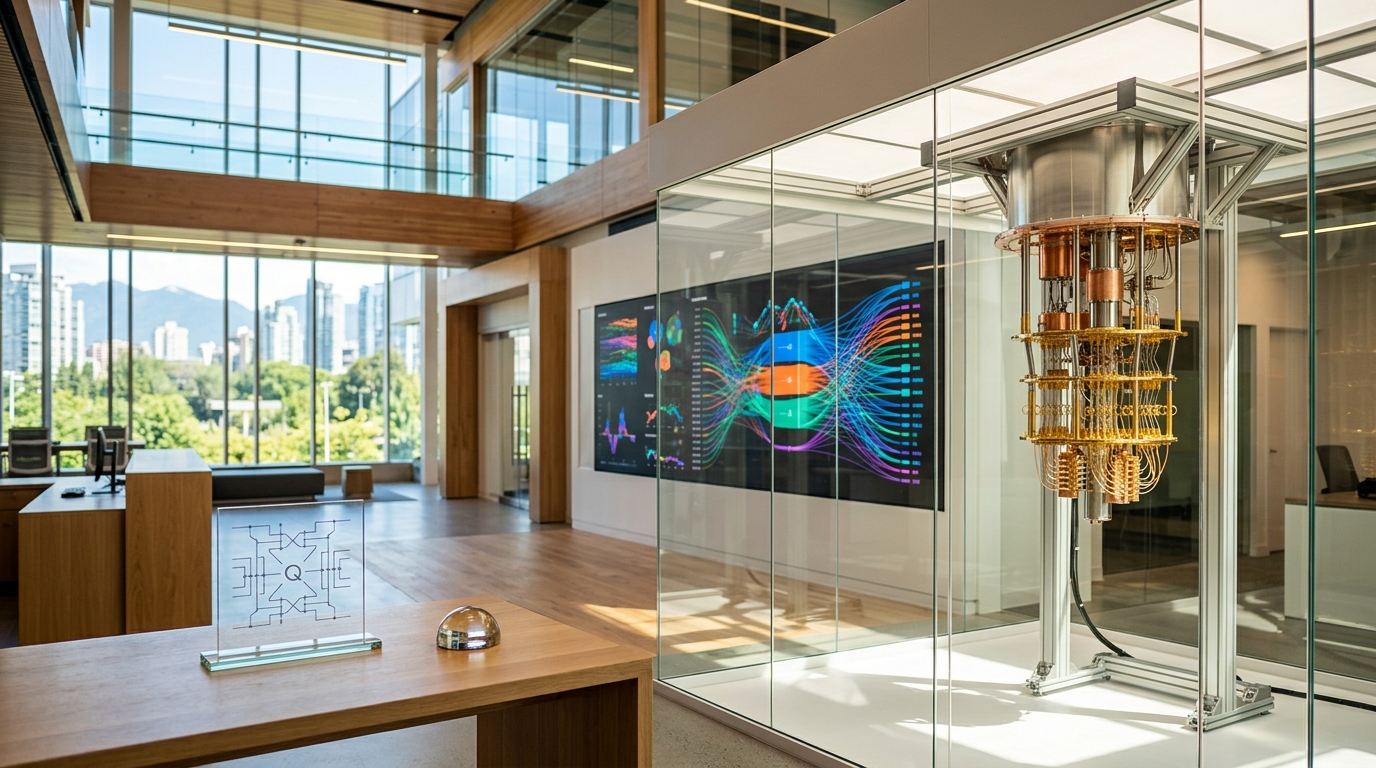
D-Wave Quantum has a problem most Canadian tech companies would envy: it is running out of excuses to be ignored. The company, which maintains a critical R&D hub in Burnaby, remains the only publicly traded pure-play quantum computing firm in Canada. In its most recent quarter, the company reported $2.9 million (USD) in revenue, a figure that reflects the "lumpy" nature of system sales compared to the $15.0 million (USD) reported in Q1 2025. However, the firm also recorded a record $33.4 million in bookings for the same period. For a sector that spent two decades promising relevance was five years away, these figures represent a tangible shift toward commercial viability.
That transition from lab curiosity to commercial contract is the defining story of Vancouver's quantum sector. The city has long punched above its weight on the research side, anchored by UBC's Stewart Blusson Quantum Matter Institute, which has seeded a cluster of spinouts that have collectively raised significant venture and public capital. What is changing in 2025 and 2026 is the pipeline converting that research pedigree into paying enterprise customers—particularly in financial services and logistics, where quantum optimisation use cases are closest to production-ready.
For Vancouver operators and investors, the shift from pilot to paid contract is the inflection point where quantum stops being an R&D line item and starts being a competitive moat. Firms that have already closed early commercial agreements are building proprietary data sets, refining algorithms on real-world problems, and locking in customer relationships. The window to enter the market is narrower than it was 18 months ago.
D-Wave's commercial traction provides a public benchmark. The company's fiscal 2025 results showed year-over-year revenue growth as its Leap quantum cloud service expanded enterprise uptake. D-Wave's annealing-based architecture has proven pragmatically useful for discrete optimisation problems—the exact type of challenge logistics and financial services firms need to solve at scale. The company has maintained that quantum advantage for these workloads does not require fault-tolerant qubits; it requires robust software, integration, and a customer willing to invest in the learning curve.
The second generation of Vancouver quantum firms is quieter about its contracts, as enterprise clients in banking and supply chain are often hesitant to advertise that they are running production workloads on emerging hardware. However, the activity is visible in funding signals and hiring patterns. National Research Council IRAP quantum grants to BC firms have increased in the 2024–2025 cycle, a leading indicator that companies are moving from concept to commercialisation. IRAP's mandate targets firms with near-term revenue potential, placing these grant recipients closer to market than their predecessors.
NSERC Alliance grants, which require industry co-investment, tell a similar story. Alliance grants in quantum-related disciplines at UBC and SFU have increasingly listed financial services and logistics firms as co-applicants, a structural sign that enterprise buyers are writing cheques to shape the research agenda toward their specific problems.
Metro Vancouver possesses a concentration of quantum-trained researchers that few North American cities can replicate. UBC's SBQMI has produced graduates who hold senior technical roles across the quantum stack. When a logistics firm in Richmond wants to run a quantum optimisation pilot, it can hire or contract locally with a depth of bench that remains a genuine, time-limited advantage for Vancouver-based enterprise buyers.
The BC Tech Association's quantum working group has been mapping this ecosystem, and its member directory reflects the maturation: fewer pure research outfits and more companies with product roadmaps and named enterprise pilots.
For investors, the question is which firms in the Vancouver cluster have crossed the threshold from pilot to paid, and whether their early commercial relationships are defensible. D-Wave's public disclosures offer one data point. Private-market firms are harder to read, but funding rounds with strategic investors—particularly corporate venture arms from the financial services sector—are a reasonable proxy for commercial traction.
The risk remains: quantum-as-a-service is not a winner-take-all market. The optimisation problems that quantum handles well today are narrow, and classical computing continues to evolve. Several well-funded Vancouver firms are betting that their head start in domain-specific algorithms will compound into defensible positions before classical alternatives catch up. That is a plausible thesis, provided the firms maintain the execution discipline required to scale.
D-Wave's trajectory—from Burnaby lab to NYSE listing—serves as the proof of concept that the rest of the Vancouver quantum cluster is selling. The next 18 months will determine whether this talent advantage translates into a durable regional industry or a series of strategic acquisitions.