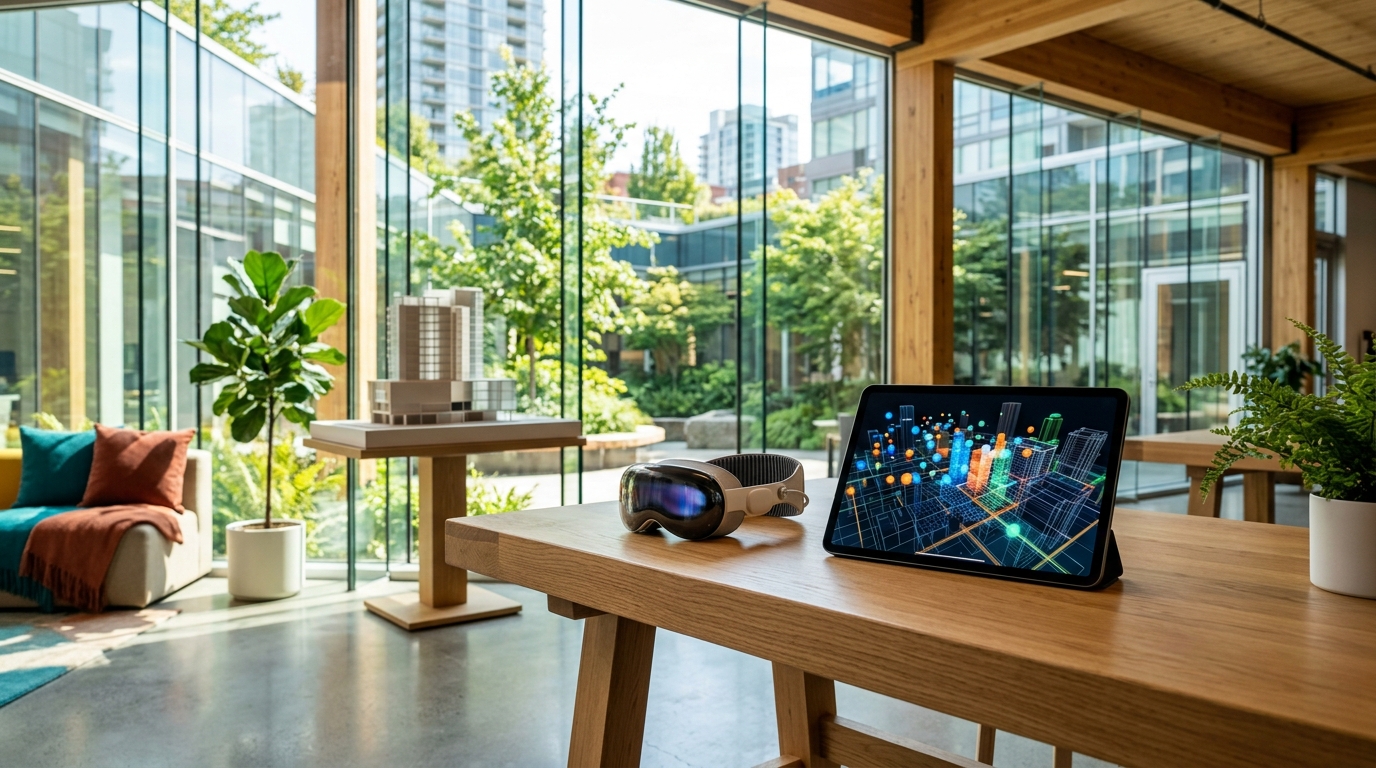
Apple’s enterprise team is increasingly focusing on markets where spatial computing offers immediate, tangible value. Rather than targeting general tech firms, the strategy centres on industries where the ability to visualize complex projects in 3D is a competitive necessity: architecture and visual effects (VFX).
Vancouver is emerging as a critical hub for this rollout, joining cities like London and Tokyo. The city’s unique concentration of talent in these sectors makes it a natural proving ground for enterprise spatial workflows.
The Apple Vision Pro carries a baseline enterprise price of approximately US$3,499 per unit. For an architectural firm or a film studio, this cost is often offset by the efficiency gains of replacing physical mockups or reducing expensive rendering cycles. It is a logic similar to the adoption of the iPad in professional fields a decade ago: hardware becomes an asset when it eliminates more costly, traditional processes.
Vancouver’s structural advantage is well-documented. The region is home to hundreds of VFX and interactive media companies, according to DigiBC, the province’s digital entertainment industry association. When combined with a mature engineering sector, a deep-rooted game development community, and proximity to world-class research at UBC, the city possesses a pre-built talent base for spatial computing that would take other regions years to assemble.
The current opportunity mirrors the rise of game middleware in the early 2000s. Vancouver studios that built internal tools—such as physics engines and rendering pipelines—eventually realized these tools held more value than the games themselves. Companies like Radical Entertainment helped establish Vancouver as an IP exporter. Developing visionOS tooling presents a similar, early-cycle opportunity.
The architecture sector offers the clearest near-term use case. Firms using spatial computing for design review can collapse feedback loops that currently require multiple physical mockups. The Architectural Institute of BC represents more than 5,000 members—a substantial market for developers building visionOS tools tailored to Canadian building codes and mass-timber construction.
For film and VFX, the proposition is equally concrete. Pre-visualisation—the process of blocking out complex sequences—is currently limited by flat screens. Spatial computing eliminates the translation gap between a director’s vision and a 2D interface. Studios that adopt this technology early will secure faster production cycles, while developers building these tools stand to capture recurring licence revenue.
Apple’s visionOS SDK has matured to include enterprise APIs for CAD integration and multi-user collaboration. While specific Canadian developer data is not public, the local ecosystem is clearly positioning itself to capitalize on these capabilities.
The window for first-mover advantage is open. Vancouver’s edge lies in the density of its VFX, game development, and AEC talent, supported by Creative BC, which is already oriented toward supporting digital production and IP development.
For local founders, the question is not whether spatial computing will become a significant enterprise category, but whether Vancouver will capture the IP layer or remain a service market. The next 18 months will be decisive.