Picture the corner of a Burnaby arterial you have driven past a hundred times: a flat-roofed convenience store, a nail salon, a shuttered dry cleaner, and a sea of cracked asphalt that fills up at noon and sits empty by eight. It is nobody's idea of a vibrant neighbourhood node. But to a growing cohort of small and mid-scale Metro Vancouver developers, that parking lot is the most interesting piece of land on the block.
Strip mall redevelopment has quietly become one of the few remaining affordable entry points into Metro Vancouver's notoriously expensive development landscape. After a cluster of rezoning approvals in the past six months, the template is coming into focus. The sites that work share a recognizable profile: single-storey commercial on a parcel of 15,000 to 40,000 square feet, surface parking that eats 40 to 60 per cent of the lot, arterial frontage with bus service, and a land value that, while rising, has not yet been bid up to the level of transit-adjacent residential land. According to BC Assessment data, many of these parcels are still assessed primarily on their commercial income potential rather than their redevelopment value — a gap that creates the acquisition opportunity.
The inventory is enormous. Metro Vancouver's land use data points to more than 2,000 neighbourhood commercial parcels across the region classified as single-storey retail with surface parking. That is a significant pipeline, and most of it has barely been touched. Colliers' Q1 2026 retail data puts arterial vacancy across Metro Vancouver at 6.8 per cent — meaningfully higher than transit-corridor retail — which is suppressing rents and keeping seller price expectations in check on the weaker sites. For a developer with patience and the right municipal relationships, that is a buying window.
Why now, and why these sites? The economics hinge on a few converging factors. Land assembly — the traditional path to density in Vancouver — has become expensive and complex, often requiring the consolidation of four to eight strata-titled or individually owned lots. A strip mall, by contrast, is frequently a single parcel under a single owner, often an estate, a private family holding, or a small commercial landlord facing succession pressure. The transaction is cleaner, the negotiation is bilateral, and the carrying costs before rezoning are partially offset by existing tenancy income.
Municipal policy has also shifted materially in favour of these sites. Burnaby's Metrotown and Edmonds area plans now explicitly incentivize strip mall consolidation with density bonuses, recognizing that these parcels sit at the intersection of arterial transit and established residential neighbourhoods — exactly where the Metro Vancouver Regional Growth Strategy wants to add density. New Westminster's Official Community Plan updates have similarly created a clearer pathway for mixed-use rezoning on arterial commercial sites. The City of Vancouver's own neighbourhood commercial corridor policies have approved several applications in East Vancouver over the past year where the site profile matched — ground-floor retail retained or expanded, residential above, and active frontage maintained.
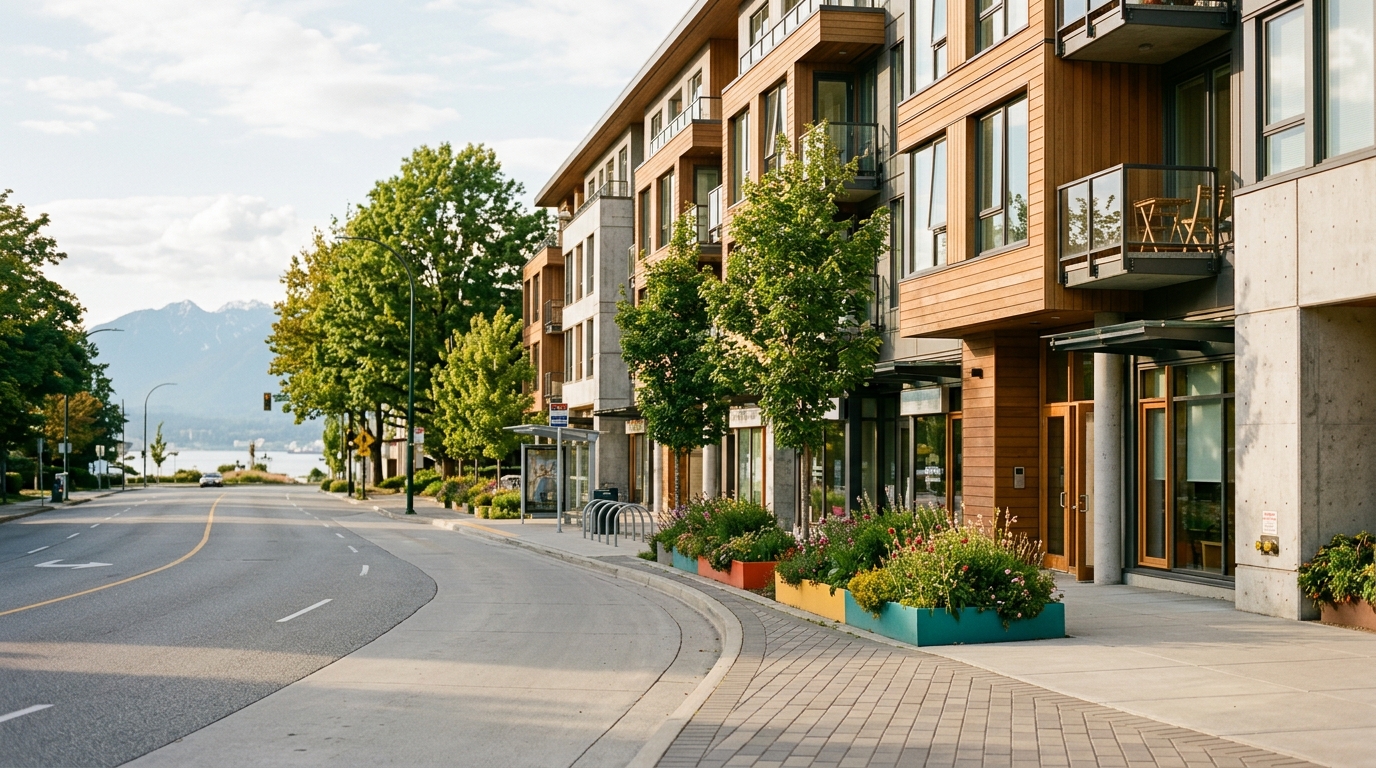
The replicable template. Projects that have cleared rezoning share several design and programmatic features. Ground-floor commercial is preserved or increased — typically 3,000 to 8,000 square feet of leasable retail space — satisfying both municipal requirements and neighbourhood advocates. Above that, four to eight storeys of residential are common, usually a mix of market rental and, increasingly, below-market units to meet inclusionary requirements. Structured or underground parking replaces the surface lot, improving the site's public realm. The density achieved — typically an FSR of 2.5 to 3.5 — is high enough to make the pro forma work without requiring the kind of tower economics that demand institutional capital.
This is not a game dominated by the major Vancouver development houses. The cohort active in strip mall redevelopment skews toward UDI Pacific Region's small and mid-scale developer membership — firms with one to five projects in their pipeline, often family-owned or founder-led, with deep knowledge of a specific submarket. They are operating in a niche that larger developers have historically found too granular and too operationally intensive.
The approval pathway. The average mixed-use rezoning timeline in Metro Vancouver runs 18 to 36 months, depending on the municipality. Burnaby has been faster on sites that align with its area plans. Vancouver's process remains longer and more variable, with the public hearing stage introducing the most uncertainty. New Westminster sits in the middle.
The friction points are predictable: parking ratios, tenant displacement, and heritage or character overlays. Developers who have navigated these successfully tend to bring tenants into the conversation early, propose phased construction that keeps at least some commercial space operational during the build, and engage the local business improvement association before the formal application is filed.
What it means for tenants and neighbourhoods. Redevelopment means displacement, at minimum temporarily, and not every small business survives a forced relocation. The projects that have earned community support have generally offered right-of-first-refusal on new ground-floor space at pre-construction rents, and some have worked with the municipality to identify interim locations. Expect tenant protection requirements to become standard in rezoning approvals over the next 18 months.
For the residential supply pipeline, the aggregate contribution is meaningful. If even 10 per cent of Metro Vancouver's 2,000-plus eligible parcels were redeveloped at modest densities over the next decade, the unit count would be significant. CMHC's Housing Supply Challenge data consistently identifies this type of infill as among the highest-value additions to the regional supply mix.
The bottom line. Strip mall redevelopment isn't a silver bullet, and it isn't without complexity. But for developers willing to work at the neighbourhood scale, manage tenant relationships carefully, and navigate a 24-to-30-month approval process, the economics are increasingly compelling. The template is proven, the inventory is large, and the entry price remains accessible. For small and mid-scale developers looking for a viable path in a market that has otherwise narrowed considerably, this may be the most interesting lane open right now.
What to watch: Burnaby's next round of Edmonds area plan amendments, expected in late 2026, may expand the density bonus envelope further. Vancouver's Broadway Plan implementation will also test whether the mixed-use arterial template can be accelerated through pre-zoning.



