When Bowery Farming shut down in November 2023 and AppHarvest filed for Chapter 11 protection in July 2023, institutional capital exited the sector. Vertical farming shifted from venture darling to cautionary tale within eighteen months, and the valuations that once justified hundred-million-dollar greenhouse builds evaporated. The first wave of controlled environment agriculture (CEA) bet on scale, leafy greens, and grocery-chain distribution. It failed.
The operators still standing in British Columbia largely avoided that playbook. Those now quietly expanding operate a model so distinct from the first wave that calling it the same industry requires a generous definition.
The unit economics reset
The core failure of first-wave vertical farming was straightforward: high capital expenditure, commodity crop prices, and energy costs that did not pencil out. Bowery’s facilities produced romaine at margins that could not survive a rate cycle. The lesson BC’s second-wave operators absorbed is that the crop mix—not the technology—determines viability.
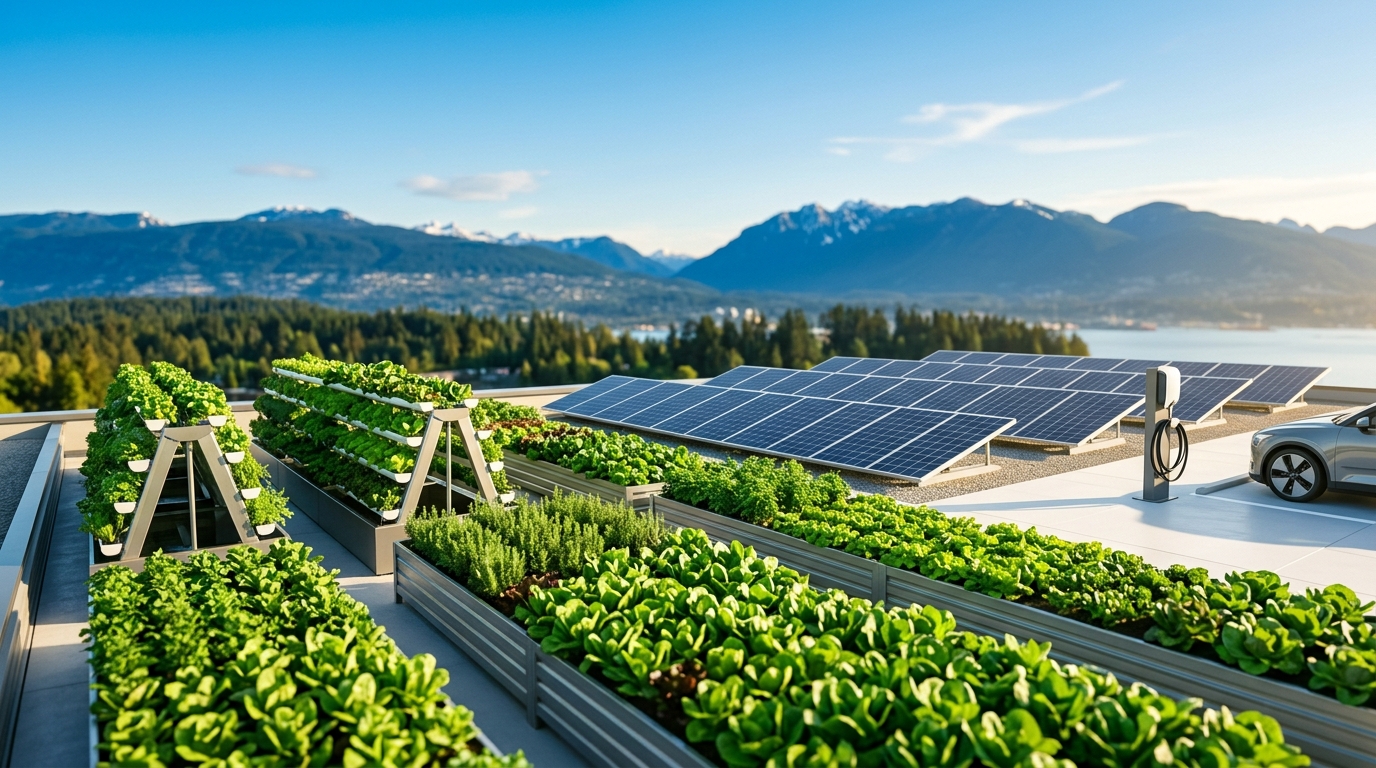
High-value, short-cycle crops are now the default: culinary herbs, microgreens, edible flowers, specialty mushrooms, and pharmaceutical-grade botanicals. These categories command retail and foodservice prices three to ten times higher per kilogram than commodity lettuce, and their controlled-environment requirements create a genuine moat against field-grown competition. BC’s Ministry of Agriculture and Food has identified high-value CEA crops as a priority segment in its agritech development framework, recognising that the province’s climate makes field production of many specialty crops economically marginal.
Municipal contracts: the anchor tenant model
The most structurally significant shift is the emergence of municipal food security contracts as a financing anchor. Metro Vancouver’s Regional Food System Action Plan includes explicit commitments to increase local food procurement for civic facilities—hospitals, schools, and municipal food programs—to build regional supply chain resilience. For CEA operators, a multi-year municipal supply agreement provides predictable revenue, enabling infrastructure financing.
The model borrows from the renewable energy sector’s power purchase agreement playbook. By locking in a long-term offtake contract with a creditworthy public counterparty, operators secure project financing at reasonable rates, building to serve the contract rather than speculating on spot market demand. It is less glamorous than a grocery partnership, but significantly more durable.
The data centre heat equation
The most technically novel element of BC’s second-wave CEA is waste-heat co-location. The Fraser Valley’s accelerating data centre buildout—driven by hyperscaler demand for BC Hydro’s relatively clean and affordable grid power—generates substantial volumes of waste heat. BC Hydro’s commercial rates make the province attractive for data centre development, but the thermal byproduct of server cooling represents a significant operational cost for greenhouse operators who would otherwise pay to heat their facilities through BC’s shoulder seasons.
Co-location arrangements—where a CEA facility is built adjacent to or integrated with a data centre, capturing exhaust heat through a heat exchange system—can materially reduce the energy cost structure that hindered first-wave operators. Research from UBC’s Faculty of Land and Food Systems has examined the thermodynamic potential of waste-heat integration in CEA contexts. Heating accounts for a substantial share of year-round operating costs in BC’s climate; eliminating or reducing that load significantly improves the margin profile.
The data centre land rush in the Fraser Valley is creating a geographic convergence that BC’s CEA operators are beginning to exploit. The infrastructure is being built; the question is whether agricultural operators can negotiate the co-location agreements before the heat is vented.
The investor re-entry case
For investors who wrote off CEA after 2023, the sector’s reset deserves a second look. Technology risk has decreased; the engineering of plant factories is well understood, and equipment markets have matured. The remaining risks are execution, crop selection, and contract origination—manageable business risks rather than existential technology bets.
Valuations reflect the sector’s reputational damage. Innovate BC’s agritech portfolio includes CEA-adjacent companies raising at multiples that would have been unthinkable in 2021. The BC Greenhouse Growers Association represents a mature segment of the industry whose conventional greenhouse operators provide a useful benchmark for what stabilised CEA economics can look like at scale.
The investors who will succeed in vertical farming’s second act are those who understand they are underwriting a food infrastructure business with a municipal anchor tenant, not a technology startup with a grocery store exit. The crop is different, the customer is different, and the capital structure should be different. The operators who have figured that out are already growing.
Reality check
The sector’s challenges remain. Energy costs are the central variable; any significant move in BC Hydro’s commercial rates reshapes the economics. Municipal procurement processes are slow, and long-term food supply contracts remain novel for most BC municipalities. Waste-heat co-location agreements require negotiating with data centre operators whose core business is not agriculture, and the technical integration is non-trivial. Labour cost structures have not fundamentally changed, and while automation is improving, it remains capital-intensive.
What has changed is the baseline expectation. First-wave vertical farming was priced for perfection. Second-wave BC operators are priced for a difficult business that works if run correctly. That is a more honest starting point—and, for the right investor, a more interesting one.