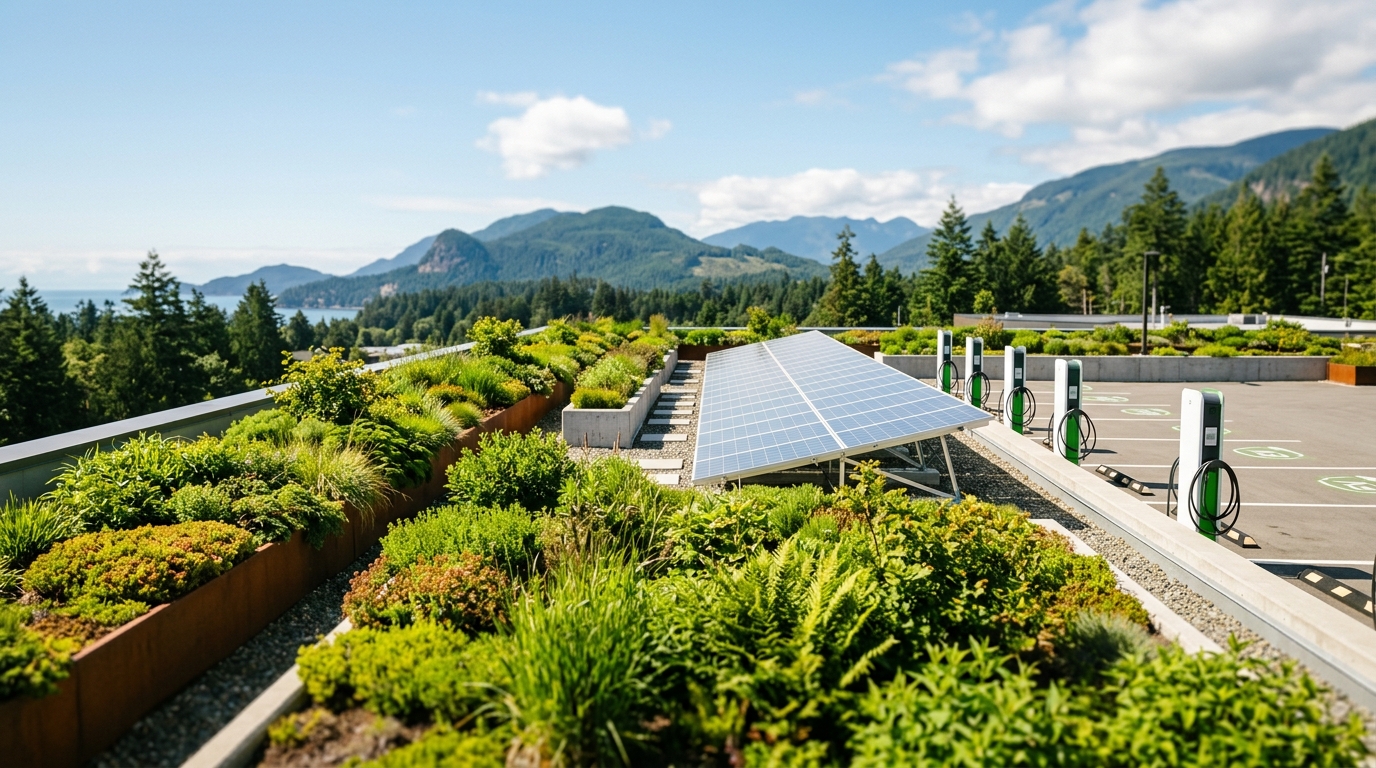
For most commercial property owners, stormwater has long been a liability—water flowing off roofs and parking lots that becomes someone else's problem at a significant expense. That accounting is changing. A cluster of Metro Vancouver municipalities is piloting utility fee structures that flip the equation: manage water on-site, and the municipality provides a financial incentive.
The mechanism is straightforward. Under stormwater credit programs, municipalities charge property owners a fee based on impervious surface area—the pavement, rooftops, and hardscape that shed rainwater into the storm system. Property owners who invest in green infrastructure—such as rain gardens, green roofs, and permeable paving—can earn credits to reduce or eliminate that fee. In advanced programs, these credits can be traded or banked, creating a secondary market.
Recent legislative updates like Bill 36 (2023) have expanded how municipalities fund drainage through development, complementing existing powers to establish utility-style fees. Surrey and Burnaby are among the municipalities now in the pilot phase, working through fee schedules and credit frameworks ahead of broader rollouts.
The Business Case
The scale of the underlying infrastructure problem explains why municipalities are motivated to share costs with the private sector. Metro Vancouver faces billions in projected costs for stormwater infrastructure over the next two decades, driven by aging pipe networks, increasing rainfall intensity due to climate change, and urban densification.
The Philadelphia model is instructive. That city launched its Green City, Clean Waters program in 2012, pairing a stormwater utility fee with a robust credit system. Since then, the program has transferred more than $200 million USD in infrastructure costs to private landowners who manage runoff on-site. Portland's Clean River Rewards program operates on similar logic and has been studied by the US Environmental Protection Agency as a replicable model.
For a commercial property owner in Metro Vancouver, the math is worth modelling now. A mid-sized industrial property could face a stormwater utility fee of several thousand dollars annually once programs mature. A green roof or permeable paving retrofit that earns full credits eliminates that fee and, in a trading scenario, generates revenue. Engaging early, before rates are locked, is strategically valuable.
The Startup Layer
A cohort of BC-based environmental services companies is positioning to capture this market. Firms like I-Sustain are among those providing the expertise required for site assessment, green infrastructure design, and ongoing performance monitoring.
The service stack involves several layers. Property owners require assessments of their impervious surface area and hydrological modelling to determine which green infrastructure will qualify for credits. Post-installation, programs typically require ongoing performance monitoring—verifying that a rain garden is retaining the volume of water the credit assumes. This requirement for sensors, data reporting, and third-party verification is where technology-forward startups differentiate themselves from traditional civil engineering firms.
Navigating Uncertainty
The opportunity is significant, but several variables remain. First, fee schedules are still being calibrated. The revenue potential for property owners scales directly with the fee level; programs priced to reflect the true cost of grey infrastructure generate the most meaningful returns.
Second, credit transferability remains unconfirmed in many BC pilots. Without the ability to trade credits between properties, the market for property owners is narrower.
Third, program continuity is subject to political cycles. Unlike Philadelphia’s program, which is embedded in a consent agreement with the US EPA, local programs lack that specific external accountability mechanism. Despite these uncertainties, engaging with the pilot process through municipal consultations and industry associations allows property owners and founders to help shape the rules, positioning them to profit as the market matures.
The Strategic Window
Metro Vancouver's stormwater credit programs are where voluntary carbon markets were a decade ago: the infrastructure of rules, verification, and trading is being built in real time. For commercial property owners with large impervious footprints—industrial operators, big-box retail, and surface parking owners—the case for engaging with pilot programs now is clear. For cleantech founders, the window for technical differentiation is open, but it will not stay that way as larger engineering firms pivot to this space.